Cosmic Cycles
Reading the Universe
The sky keeps time on scales humans forget to measure. The ancients didn’t forget. Here’s what they were watching, what’s actually moving up there, and what’s in the sky right now.
The Sky, Told Three Ways
Every long-lived civilisation ended up obsessed with the sky. The Sumerians, the Maya, the builders of Göbekli Tepe, the Egyptians, the Hindus — all of them, separately, watching the same thing. We now know what they were looking at. The rhythms that shaped their temples are the same rhythms that drive Earth’s ice ages, and they’re still running overhead tonight.
Part I — The First Science
The First Science
Obsessed With the Sky
Every ancient culture watched the sky. Not as a hobby — as survival. The sun told you when to plant and when to harvest. The stars told you where you were. The moon told you about tides and fertility cycles.
The Egyptians timed the Nile flood to the first morning Sirius rose just before sunrise each year. The Inca built entire buildings to catch the solstice. The Maya tracked Venus to within a day over 500 years. Polynesian navigators crossed thousands of kilometres of open Pacific using only the stars, the shape of the swells, and the flight paths of birds. Han dynasty China ran a state astronomy office for two thousand years straight.
Same obsession. Same precision. Every continent. Two explanations fit the data: either every culture independently climbed to the same level of precision, or some of it was inherited from an older source that had already worked it out. The second is contested — but the monuments keep showing up aligned to the same things, and that’s a problem that needs a real answer.
The Cataclysm In Stone
Göbekli Tepe — Pillar 43
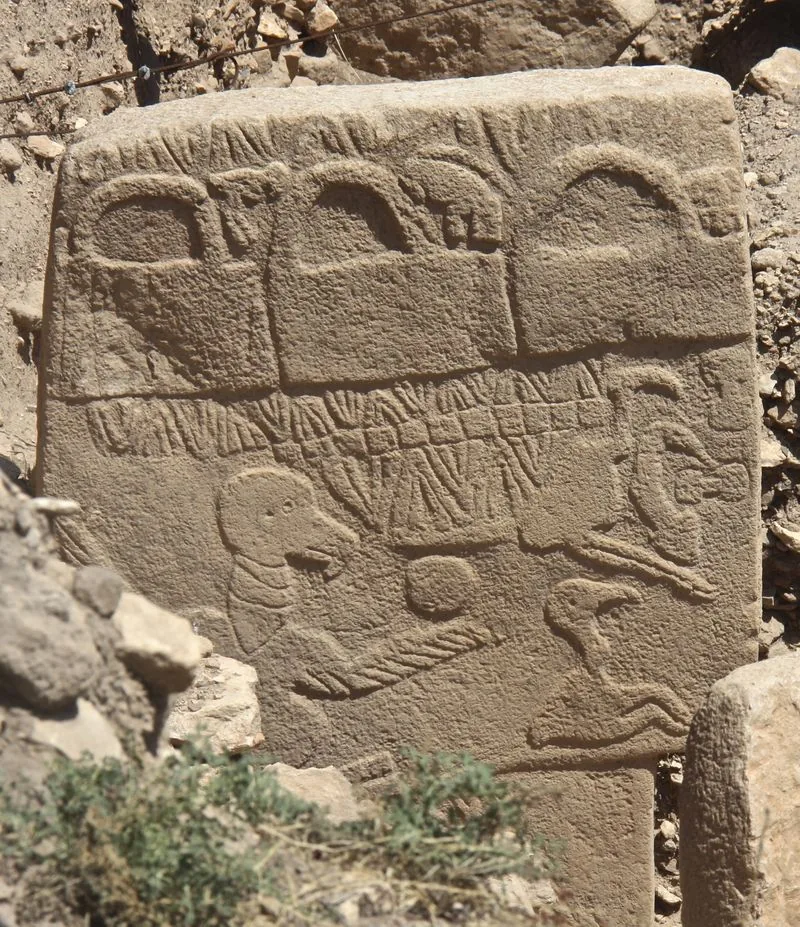
Pillar 43 at Göbekli Tepe — the Vulture Stone — may be the oldest disaster memorial we have. In 2017, Edinburgh engineers Sweatman & Tsikritsis read its carvings as a dateable star map, pinning the scene to the summer solstice around 10,950 BCE — right inside the error bars of the Younger Dryas onset.
Their reading: the vulture is Sagittarius. The disc is the sun. The smaller animals are other zodiacal constellations. The headless figure at the base marks mass death. The implied referent is the Taurid meteor complex — the same stream modern astronomers still monitor for large debris. A survivor’s warning, carved while the memory was still fresh.
The whole site was then deliberately buried around 8,000 BCE. Nobody knows why. Twelve thousand years later we dug it back up and started trying to read it. Sweatman’s interpretation is contested — mainstream archaeology reads the carvings as mythic rather than astronomical — but the solstice alignment of the pillar itself is geometry, not opinion.
Photo: Sue Fleckney / CC BY-SA 2.0 (opens in new tab) via Wikimedia Commons
The Science of Catastrophe
Cosmic Tusk — The Younger Dryas Evidence
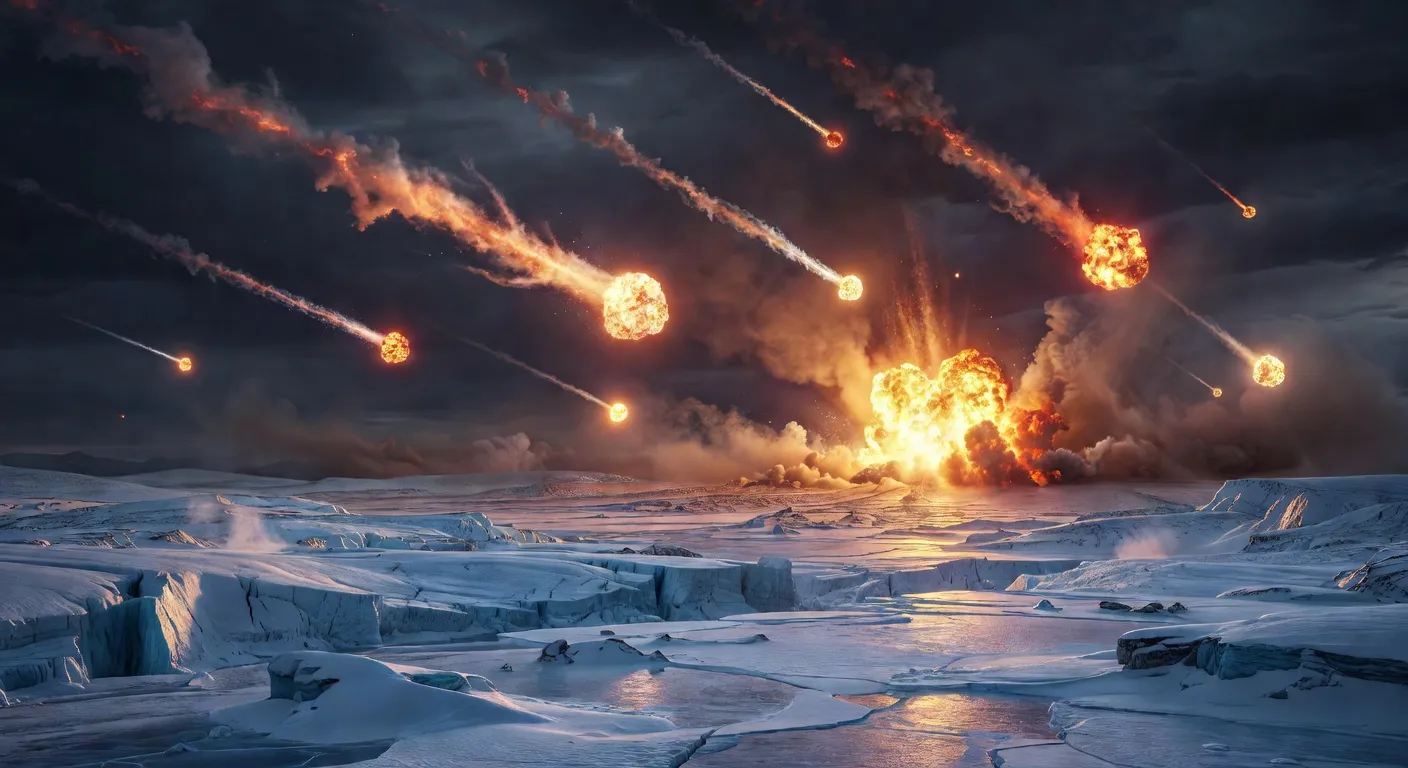
Cosmic Tusk (opens in new tab) is George Howard’s archive of peer-reviewed work on the Younger Dryas impact hypothesis — the proposal that a cometary airburst over North America around 12,800 years ago triggered the sudden cold snap, the megafauna extinction, and the reset of human civilisation.
What holds the hypothesis together is the stuff in the dirt. If you take a shovel and dig down to the layer from about 12,800 years ago, in North America or much of Europe, you keep finding the same things: tiny diamonds made by huge heat and pressure, small glass beads from melted rock, a spike in platinum, and a dark charcoal band called the “black mat.” Same layer, same stuff, different continents. The original case was Firestone et al. (2007) in PNAS. More papers have piled up since in the Journal of Geology, Scientific Reports, and the Journal of Quaternary Science.
It’s contested. Critics say those markers could come from wildfires or volcanoes. The Hiawatha crater once held up as the smoking gun got redated in 2022 to 58 million years old — way before the Younger Dryas. What the critics still haven’t explained away is the platinum, the tiny diamonds, and the fact that the black mat shows up at the same time, all over the world. The climate shift itself happened — the ice cores and the mud on the ocean floor both record it. The fight is about what pulled the trigger.
Visit Cosmic Tusk → (opens in new tab)Artist’s impression · the event itself happened 12,800 years ago and was never photographed. The evidence is the nanodiamond layer, the Hiawatha crater (Kjær et al., 2018), and the black mat.
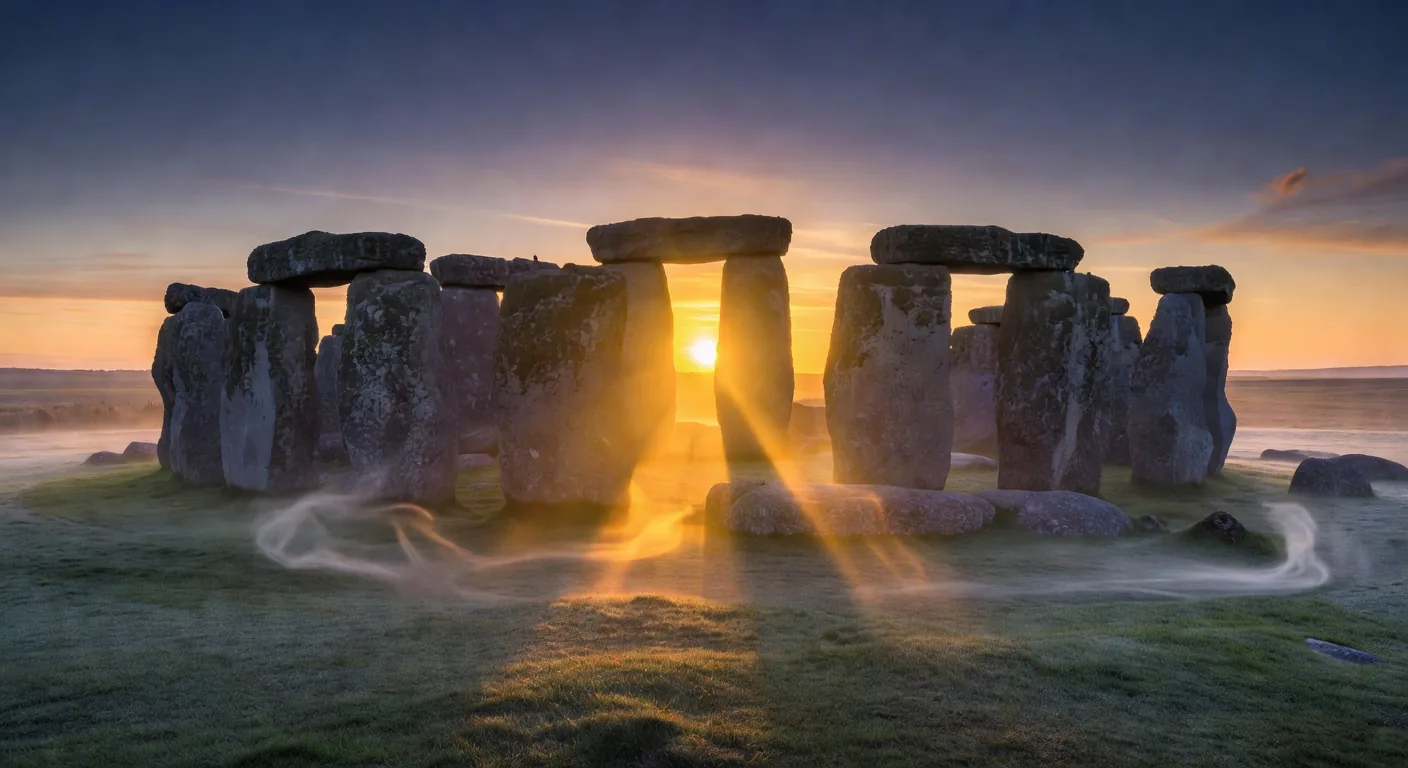
Stonehenge
The main axis locks onto the summer and winter solstices. The heel stone marks sunrise on the longest day. Sarsens up to 25 tons each, quarried 25 km away and erected around 2500 BCE, cut to tolerances a modern mason would respect. Not a farmer’s calendar — a monument built to catch specific moments in the sky with precision that would be overkill for crop timing.
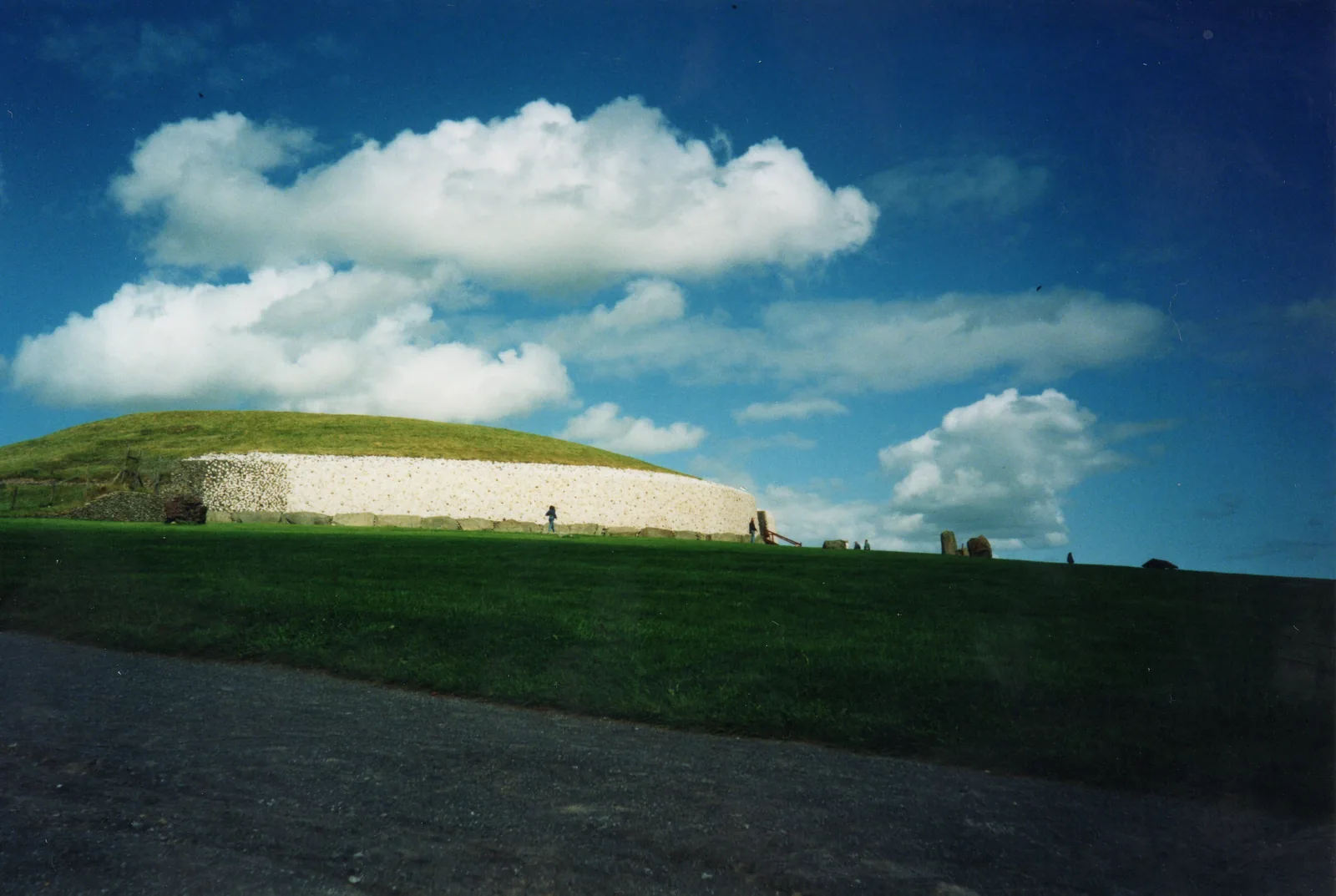
Newgrange
At winter solstice sunrise, a slit above the entrance — the “roof box” — lets a narrow beam travel 19 metres down the passage and light the rear chamber for about 17 minutes. Built around 3200 BCE, five hundred years before Stonehenge and a thousand before the Great Pyramid. Whoever laid the foundation knew exactly where on the horizon the sun would rise on the shortest day of the year.
Photo: Stanley Howe via Wikimedia Commons · CC BY-SA 2.0

Angkor Wat
On the spring equinox, the sun rises directly over the central tower as seen from the western causeway. Research by Eleanor Mannikka has shown the temple’s measurements also encode the lengths of the four Hindu yugas — the precessional ages — in units of hat (Cambodian cubits). A twelfth-century Khmer temple carrying ancient Indian cosmic numbers in its stone.
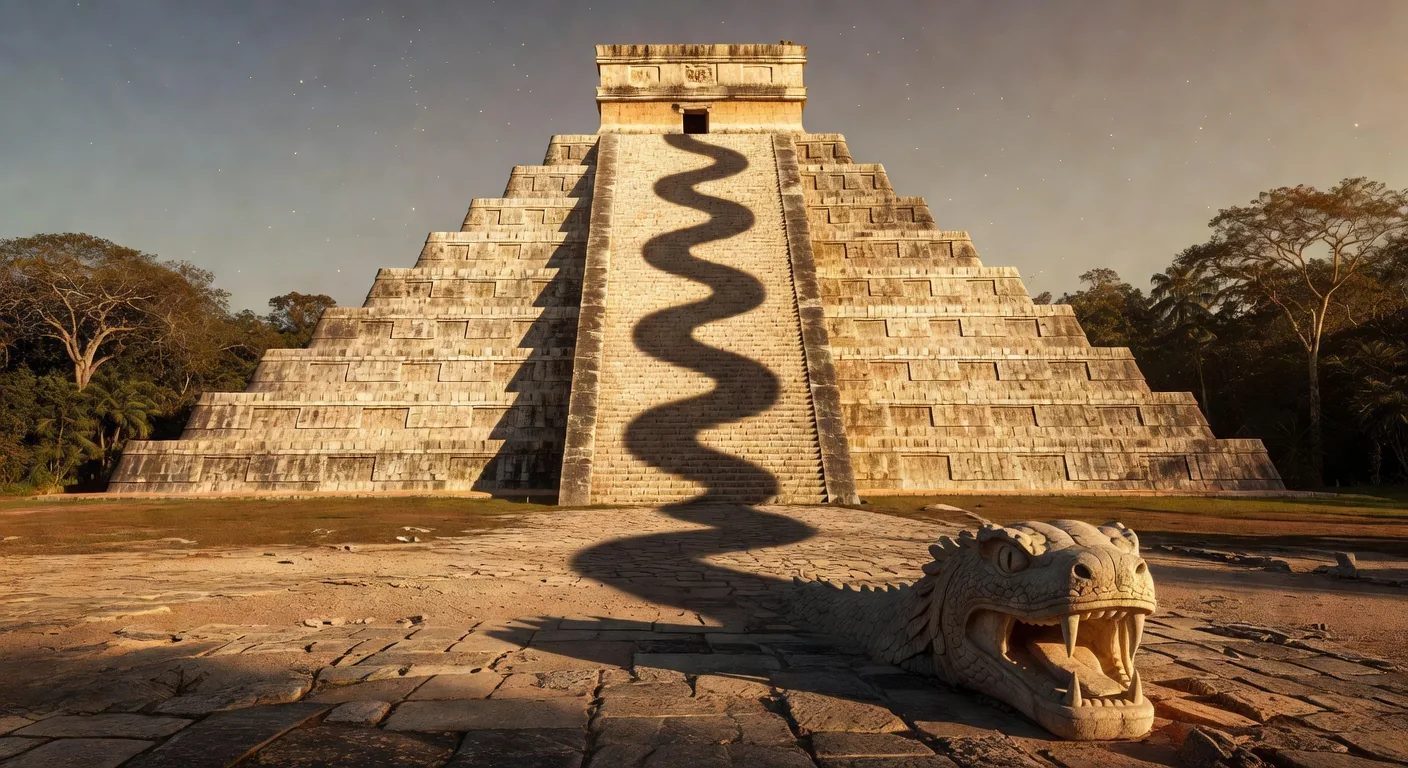
Chichen Itza
On the spring and autumn equinoxes the setting sun throws a sawtooth shadow down the northern balustrade, producing a rippling serpent that appears to descend the pyramid — Kukulkan himself returning. Ninety-one steps on each of the four sides, plus the top platform, total 365. The pyramid is a calendar, a clock, and a theatre piece, all built into one structure.
The Question
Why All the Same?
Göbekli Tepe in Turkey. Stonehenge in England. Newgrange in Ireland. Angkor Wat in Cambodia. Chichen Itza in Mexico. The Great Pyramid in Egypt. Separated by oceans and thousands of years — all aligned to the same narrow set of astronomical events. Solstices, equinoxes, stellar risings.
Only two explanations fit. Either every culture climbed to the same precision on its own, or they share an older inheritance that spread before recorded history started. The stones themselves are the evidence, and they’re built to tolerances you don’t accidentally hit twice. The sky was the textbook. The stone was the memory.
These cosmic patterns shaped the beliefs and architecture of the cultures that built them. Explore the ancient wisdom →
Sources & Further Reading
- Sweatman & Tsikritsis — "Decoding Göbekli Tepe" (2017) — Pillar 43 as a star map marking the Younger Dryas onset
- Firestone et al. — "Evidence for an extraterrestrial impact" (2007) — the PNAS paper that launched the Younger Dryas impact hypothesis
- Kjær et al. — "A large impact crater beneath Hiawatha Glacier" (2018) — discovery of a 31 km crater under the Greenland ice sheet
- Cosmic Tusk — George Howard’s curated archive of YD impact peer-reviewed papers
- Stonehenge · Newgrange · Angkor Wat · El Castillo, Chichen Itza — Wikipedia overviews of the astronomical alignments
Part II — The Deep Rhythm
Deep Time
Earth’s Cosmic Cycles
The ancients were watching because something was actually moving. Three slow rhythms in Earth’s orbit and axis, each running for tens of thousands of years, driving the ice ages and leaving a signal patient observers can catch. These are the cycles the monuments were tracking.
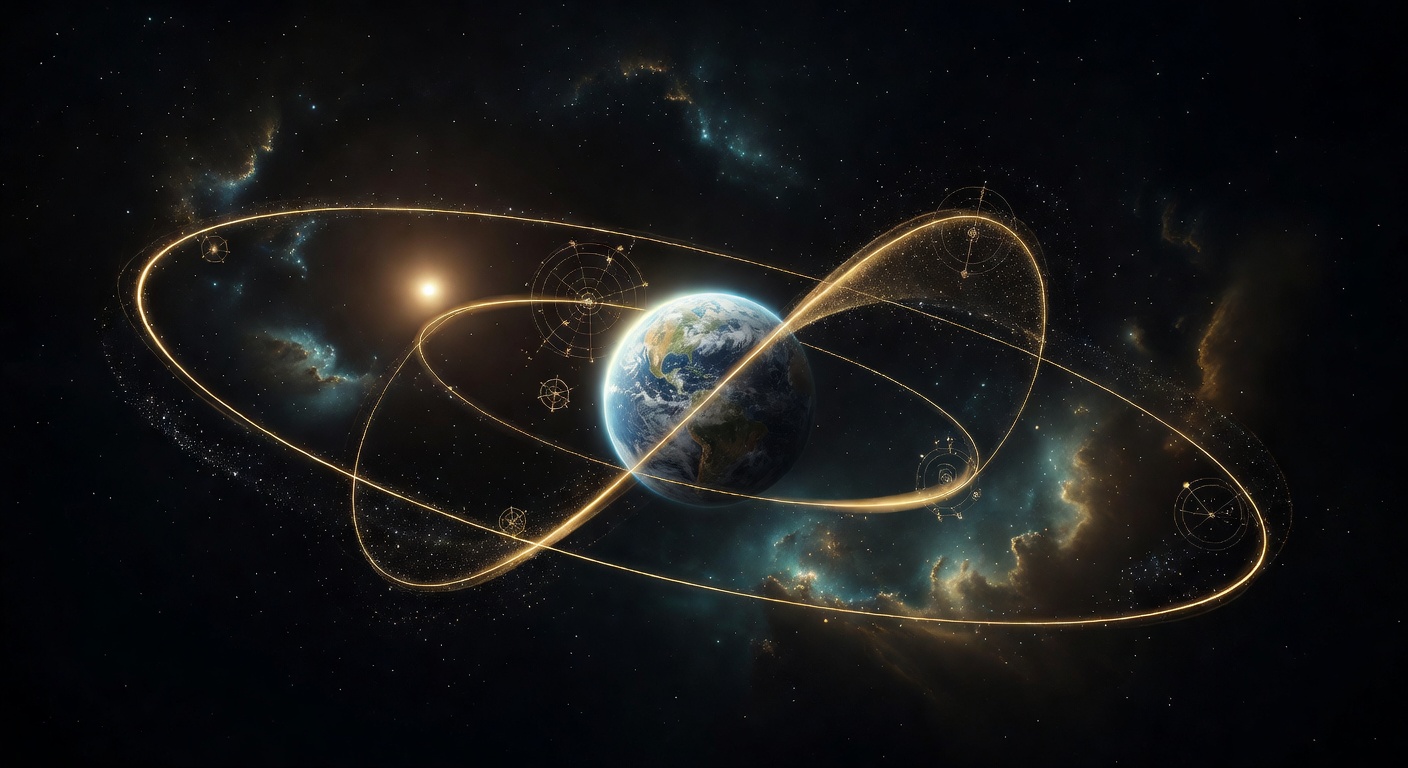
Milankovitch Theory
The Three Wobbles That Shape Every Ice Age
In 1920, the Serbian mathematician Milutin Milanković spent years of his life computing, by hand, how three slow variations in Earth’s orbit and axis would add up into a climate signal. His answer is still the best explanation for why the planet has ice ages at all.
Three cycles. Roughly 100,000 years (eccentricity — the shape of the orbit), 41,000 years (obliquity — the tilt of the axis), and 26,000 years (precession — the wobble). Half a century later, Hays, Imbrie & Shackleton (1976) drilled tubes of mud out of the deep ocean floor and measured the chemistry of tiny shells inside. All three cycles showed up in the data, clean as a bell. They called it the “pacemaker of the ice ages.” Established science, no argument.
100,000-Year Cycle
Eccentricity — The Shape of the Orbit
Earth’s orbit is not a perfect circle. It’s a slight oval, and how stretched that oval is — the eccentricity — swings between nearly circular and noticeably stretched on a main beat of about 100,000 years, with overlapping beats at 413,000 and 95,000 years layered on top.
When the orbit is more stretched, one hemisphere catches extra sunlight when Earth is closest to the Sun, while the other gets milder summers. Summer temperature is what decides whether glaciers grow or retreat — cool summers mean last winter’s snow survives — so this lopsidedness matters more than it looks. The 100,000-year rhythm in the last million years of ice-core and ocean-mud data is the eccentricity signal, staring right back at us.
41,000-Year Cycle
Obliquity — The Nodding Axis
The axis is currently tilted 23.4 degrees off its orbital plane. The tilt is not fixed. It rocks between 22.1 and 24.5 degrees on a 41,000-year cycle, and right now it is decreasing — we are slowly heading back toward minimum obliquity.
More tilt means sharper seasons: hotter summers, colder winters, stronger polar sunlight swings. Less tilt means milder seasons and, crucially, cooler polar summers — conditions that let ice sheets survive and grow. From about 2.6 million to 1 million years ago the ice-age rhythm matched obliquity directly, ticking at 41,000 years. Then something changed and the 100,000-year eccentricity beat took over. The reason for that switch is still an open question in climate science.
~26,000-Year Cycle
Precession — The Great Wobble
The fastest of the three Milankovitch cycles. Earth’s axis traces a slow cone against the stars, completing one full wobble every 25,772 years. This changes when in the orbit each season falls — which hemisphere is tilted toward the Sun when Earth is closest to it, and which when Earth is farthest. Stacked on top of eccentricity and obliquity, precession amplifies or dampens the climate signal the other two produce.
Precession is also the only Milankovitch cycle visible to the naked eye in historical time. The pole star drifts. Polaris is temporary. Around 3000 BCE it was Thuban in Draco; around 12,000 BCE it was Vega. The spring equinox slides backwards through the zodiac at roughly one sign every 2,160 years. A careful observer watching across a lifetime would not see it; a careful tradition watching across centuries would. Mainstream history credits Hipparchus with the discovery in 127 BCE. The monuments and the myths keep hinting that someone knew earlier.
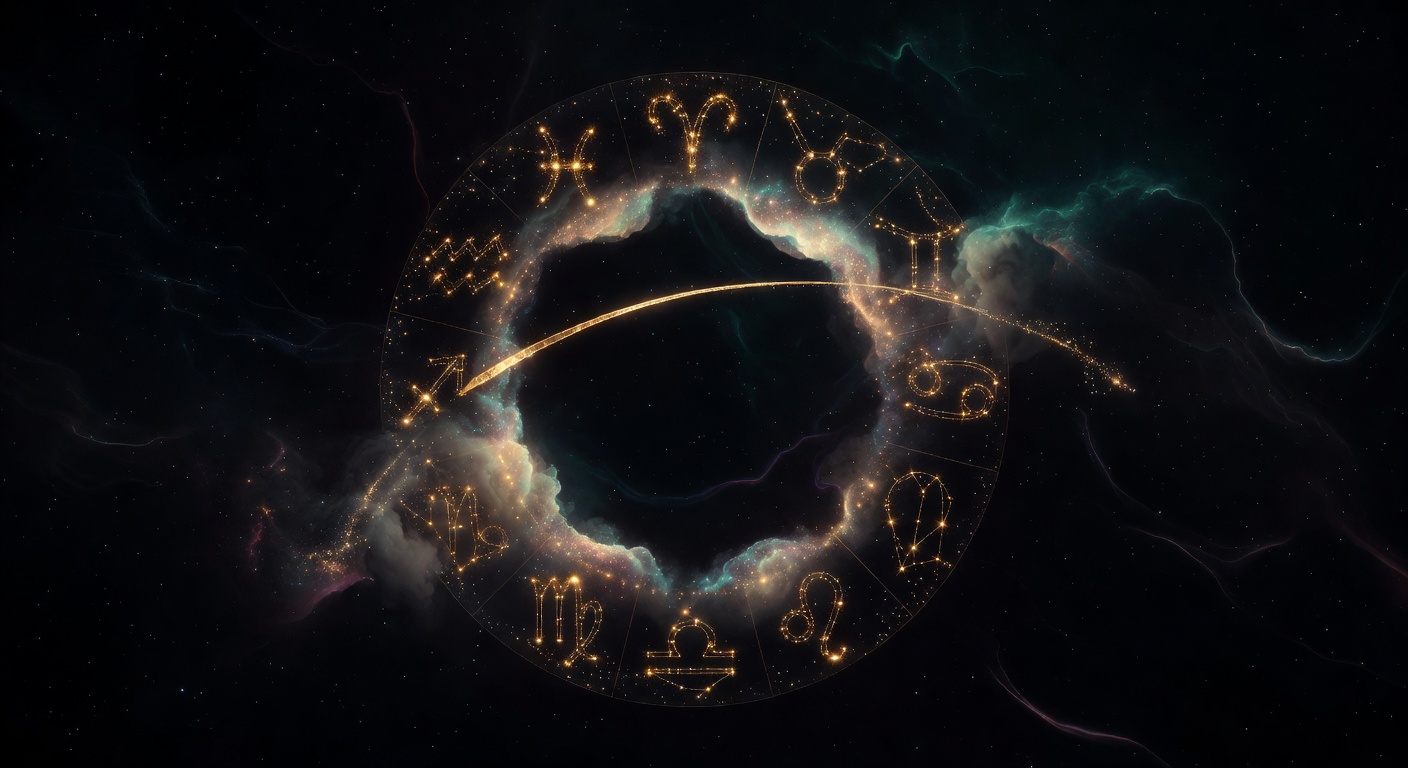
The Ages
2,160 Years Per Zodiacal Sign
At the spring equinox, the Sun rises against a specific backdrop of stars. Two thousand years ago the backdrop was Aries. Today it is Pisces, drifting toward Aquarius. Two thousand years from now it will sit fully in Aquarius. This is where the “Age of Aquarius” phrase comes from — the astronomy behind it is real, even if the horoscope industry built on top of it is not.
The arithmetic is clean: 25,920 years ÷ 12 signs = 2,160 years per age, and 2,160 ÷ 30 degrees = 72 years per degree. None of these numbers are arbitrary — they are the precessional clock. They also turn up, unannounced, in sacred texts from cultures whose official science had no idea the wobble existed.
See It Yourself
You can check this with your own eyes. Around March 20–21 (the spring equinox), go out before dawn and face east. The last constellation visible on the horizon before the Sun washes out the stars is the one the Sun is “in.” Right now that is the boundary between Pisces and Aquarius. Easier route: open Stellarium on your phone, set the date to the next equinox, and turn on constellation lines.
The drift is slow — one degree every 72 years, about half a degree in a human lifetime. You cannot feel it year to year. But a tradition of watchers, passing observations down across generations, absolutely can. And what those traditions found is exactly what the monuments and the myths keep pointing back to. That is the premise this whole site is built on.
The Encoding
Hamlet’s Mill — Four Numbers Across Four Continents
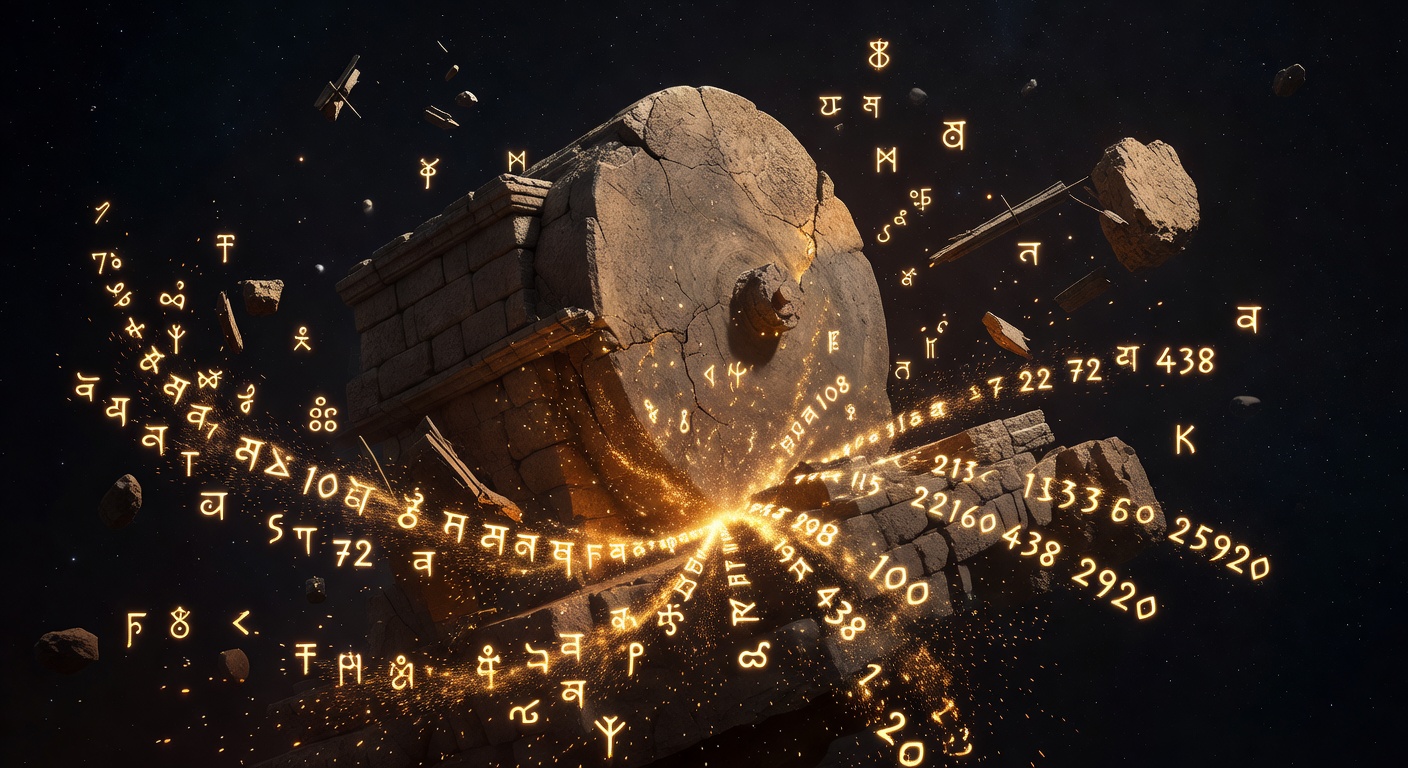
In 1969, MIT historian of science Giorgio de Santillana and Frankfurt ethnologist Hertha von Dechend published Hamlet’s Mill. The argument was uncomfortable: the same precessional numbers — 72, 108, 432, 2,160, 25,920 — keep showing up in unrelated myths as if someone put them there on purpose. Scraps of an older way of reading the sky, older than recorded history, long since forgotten. The book gets fought over. The specific numbers are what keep it alive:
Astronomy
The Great Year
25,920 years
One complete precessional wobble of Earth’s axis. Pole star drifts. Spring equinox traverses all 12 zodiacal signs. Divides cleanly: 2,160 years per age, 72 years per degree.
Hindu Cosmology
The Mahayuga
4,320,000 years
Kali Yuga: 432,000
Four yugas (Satya, Treta, Dvapara, Kali) totaling 100 zodiacal ages. Current Kali Yuga equals 200 Great Years. Sri Yukteswar argued the original cycle was 24,000 years — one precessional period split into ascending and descending halves.
Norse · Grímnismál
Valhalla Warriors
540 × 800 = 432,000
Valhalla has 540 doors. At Ragnarok, 800 warriors ride out of each. Total: 432,000. Exactly the years in the Hindu Kali Yuga. Iceland and India never met. The same number.
Babylon · King List
Ten Antediluvian Kings
432,000 years
The Sumerian King List records ten kings who reigned before the Flood for a total of 432,000 years. Same number as Valhalla, same number as Kali Yuga. Three unconnected cultures.
Mesoamerica · Maya
The Long Count
5,125 years
One Long Count cycle = ~1/5 of a Great Year. Five cycles complete one precession. The 2012 ‘end date’ marked the completion of one such cycle. Mesoamerica had no contact with India or the Near East.
India · Rigveda & Mala
The Number 108
10,800 · 108 · 432
The Rigveda contains 10,800 stanzas (de Santillana’s count). A mala has 108 beads. The Tibetan Kangyur has 108 volumes. 108 = 432 ÷ 4 = 25,920 ÷ 240. The precessional clock, hidden in plain sight.
The standard academic response is cherry-picking — if you search long enough across enough traditions, some numbers will coincide. The problem with that response is that the same specific numbers keep showing up, and every one of them is a clean multiple of 72, which is the precessional year-per-degree. You don’t stumble into that by accident.
Four continents, one arithmetic — who actually put it in print
Who knew these numbers, when, and whether it’s transmission or coincidence. Santillana, Yukteswar, Bauval, Sweatman — named scholars on both sides.
Rabbit hole detected
Deep dive →The Convergence
432,000
Hindu Kali Yuga. Sumerian king list before the flood. Norse Valhalla warriors. Three unconnected cultures. The same number. All divisible by the precessional clock — 432,000 / 72 = 6,000 degrees. 432,000 / 2,160 = 200 zodiacal ages.
The Stones
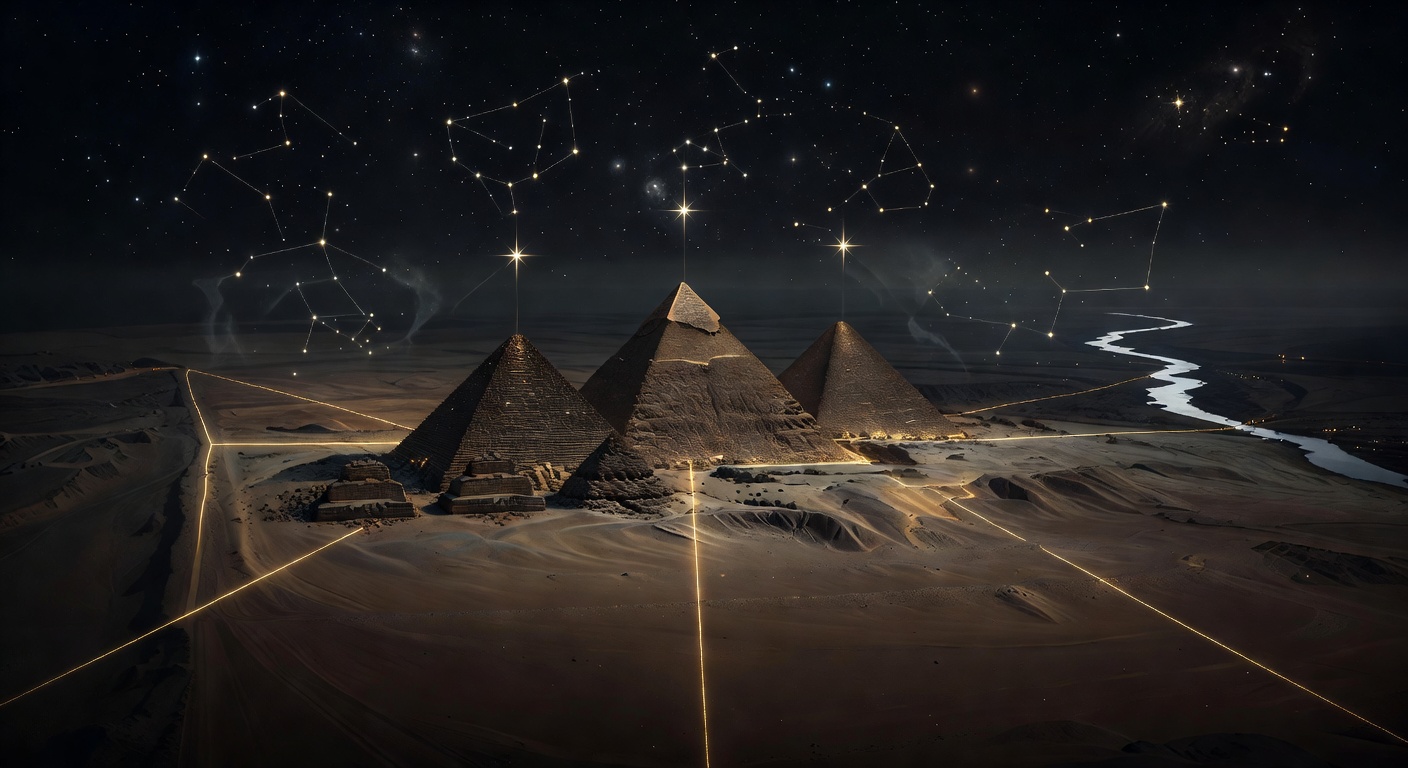
Giza, Orion, and 10,500 BCE
The Great Pyramid, officially dated to around 2500 BCE, is aligned to true north to better than 1/20 of a degree. That kind of accuracy is hard to pull off even with modern instruments. Doing it 4,500 years ago by eye means either a very clever star-based method — which only works if you already know the stars drift — or laying the alignment out for a sky the builders weren’t actually living under.
In 1994, Robert Bauval published The Orion Mystery. His core observation: the three main Giza pyramids on the ground match the three stars of Orion’s Belt in both pattern and proportion, including the small offset of the smallest pyramid from the line of the other two. Orion’s Belt slowly rotates across the sky due to precession. Running the sky backwards, Bauval’s match is exact at approximately 10,500 BCE — eight thousand years before the official construction date of the site they are built into.
That same 10,500 BCE window is where Robert Schoch’s water-erosion dating places the original Sphinx, where Plato’s Timaeus places the destruction of Atlantis, and where the Younger Dryas impact hypothesis places the event that ended the Ice Age. Three independent lines of argument, all landing in the same 12,000-year-old window. Either that’s one hell of a coincidence, or the mainstream dates are missing something big.
The Yugas
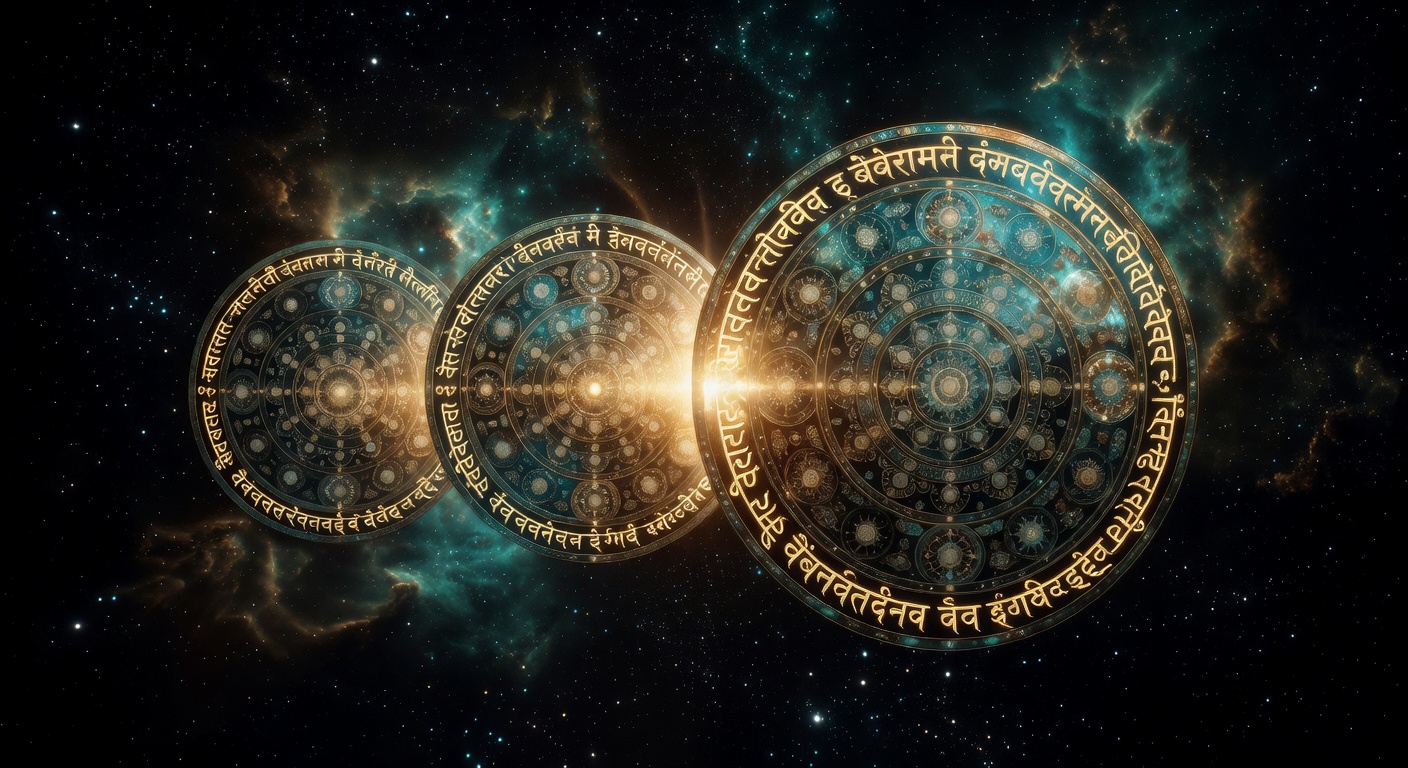
Kali Yuga as Precessional Math
Hindu cosmology divides time into four yugas — Satya, Treta, Dvapara, Kali — each shorter than the one before, together forming a Mahayuga of 4,320,000 years. The current Kali Yuga is stated at 432,000 years. That is exactly ten zodiacal ages of 2,160, and the full Mahayuga is one hundred. Those are not round numbers; they are precessional numbers. Something in the source tradition was speaking the language of the wobble.
In 1894 the Indian monk-astronomer Sri Yukteswar Giri published The Holy Science, arguing the million-year Yugas were a copying error. The original cycle, he said, was a single precessional wobble split into ascending and descending halves of 12,000 years — 24,000 total, give or take, which is close to the real period. Orthodox priests rejected it. Orthodox scholars of Indian texts ignored it. The arithmetic doesn’t. The sacred numbers and the real sky keep producing the same answer.
~12,800 years ago
“The event every culture remembers as the great flood.”
Precession is the long cycle. The Younger Dryas is what happened the last time the long cycle ran out. The full case — the tiny diamonds, the Hiawatha crater, the Carolina Bays, the big animals dying off, the meltwater pulse — sits on the Earth page, where it belongs. The mapping of every major Pleistocene catastrophe onto the Great Year wheel sits on its own pattern page.
The Honest Position
What We Can Say
The Milankovitch cycles are real, measured, and mainstream. Eccentricity, obliquity, and precession all change how solar energy reaches Earth on their own timescales, and their combined signal matches the ice-age record with a precision you can see on one chart. Every textbook about the climate has it. Precession itself runs at 25,772 years per full wobble, and the official record credits Hipparchus with the first recorded detection around 127 BCE.
What gets fought over is whether anyone else already knew the cycle before him. Three answers are on the table. One: nobody did, and the number matches in Hamlet’s Mill are cherry-picking — stare at enough cultures long enough and you’ll find 432 somewhere. Two: somebody did. Some old sky-watching tradition tracked the wobble precisely, baked it into their myths and monuments, and then lost the underlying math. The numbers we keep digging up today are leftovers. Three: patient sky-watchers across generations noticed the drift without ever having a proper theory for it, folded rough versions into their sacred stories, and that’s why bits of the right numbers keep turning up.
Our working position: option three is probably closest to the truth. The Sumerians, Egyptians, and Maya didn’t publish textbooks on precession. But they had thousands of years of continuous, state-funded sky-watching, and the sky keeps its receipts. The Great Year is the natural scale for thinking about deep human time. One wobble takes us back to the end of the last Ice Age — to the Younger Dryas, to the event every flood myth remembers. The ice ages aren’t random. And the evidence that someone, somewhere, already knew it is stronger than the textbooks let on. See how these long-arc cycles land in the conclusion.
Sources & Further Reading
- Milankovitch cycles — overview of eccentricity, obliquity, and precession
- Hays, Imbrie & Shackleton — "Variations in the Earth's Orbit: Pacemaker of the Ice Ages" (1976) — the landmark paper confirming Milankovitch from ocean cores
- de Santillana & von Dechend — Hamlet’s Mill (1969) — precessional numbers encoded in cross-cultural mythology
- Robert Bauval — The Orion Mystery (1994) — Giza–Orion alignment and the 10,500 BCE thesis
- Robert Schoch — Sphinx water-erosion hypothesis — geological evidence for a pre-dynastic Sphinx
- Sri Yukteswar Giri — The Holy Science (1894) — the Yuga cycle as a single precessional period
- Sumerian King List — ten antediluvian kings reigning 432,000 years
- Hipparchus — credited with the first recorded observation of precession, c. 127 BCE
Part III — The Forbidden Physics
The Forbidden Physics
Plasma Cosmology & the Electric Universe
Here’s a fact that should bother you more than it does. 99% of the visible universe is plasma — matter so hot its electrons have been ripped off, leaving a soup of charged particles that obeys electromagnetic forces the way wood obeys fire. Stars. Nebulae. The solar wind. The space between the galaxies. All of it.
And yet mainstream cosmology treats that plasma as passive scenery, and has to invent two kinds of invisible stuff — dark matter and dark energy — to make its equations balance. After forty years of searching, underground detectors, particle colliders, orbiting experiments, neither has been directly found. 95% of the universe, as they currently describe it, is made of things nobody has ever caught.
A Nobel laureate spent half his career saying we have the pillars wrong. The field moved him to the side. The argument never actually ended. This is where we are.
The Foundation
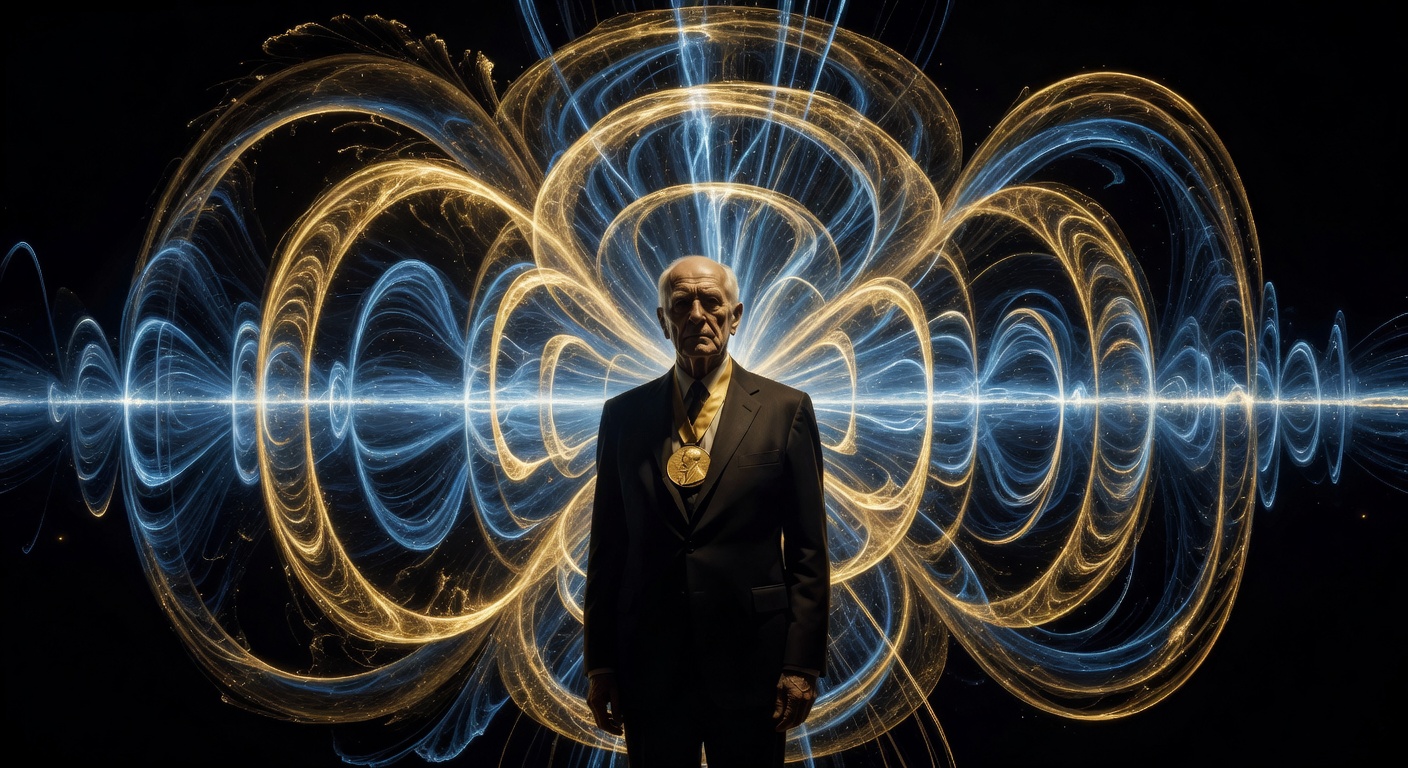
Hannes Alfvén — Nobel Prize, 1970
Hannes Alfvén was not a crank. He was a Swedish physicist who won the Nobel Prize in Physics in 1970 for founding the modern science of how plasma behaves. If you’ve ever heard of Alfvén waves, that’s him. Every textbook on the subject has his name in it. Totally mainstream, no argument.
The trouble started later. In Cosmic Plasma (1981), he argued that since the universe is overwhelmingly plasma, the electromagnetic forces moving through that plasma have to be doing real structural work at cosmic scale — more than a gravity-only model allows. Plasma self-organises into filaments. It carries huge currents. It builds stable structures that gravity on its own can’t explain. The cosmology community preferred its tidier gravity-only models. The argument wasn’t won. It wasn’t lost either. It was just quietly moved off the agenda — a Nobel laureate, politely shelved, while the field committed itself to a universe 95% made of things no experiment has ever caught.
The Astronomer
Halton Arp — The Man Who Saw Too Much
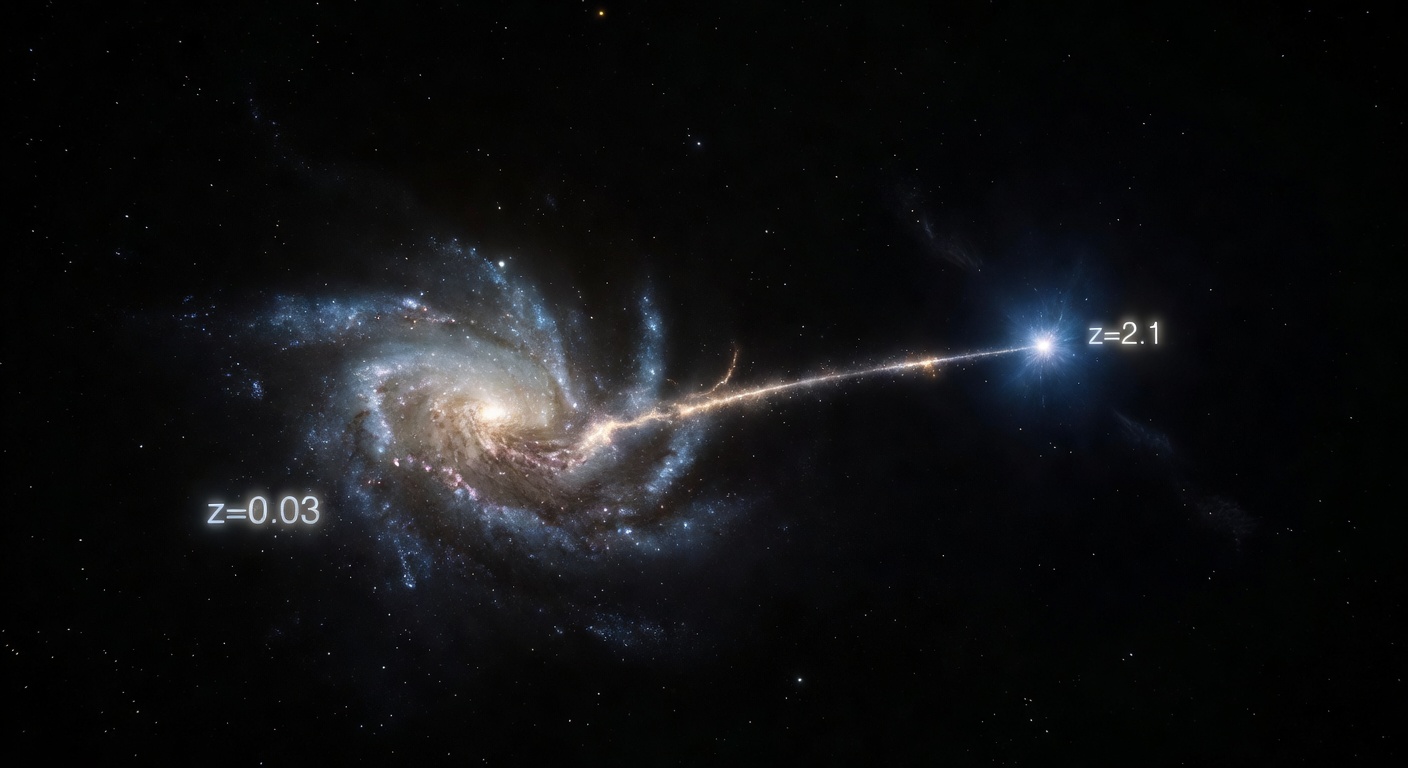
Halton Arp was a Hubble protégé, a Caltech-trained astronomer whose Atlas of Peculiar Galaxies (1966) is still a standard reference. Then he started photographing something awkward: cases where high-redshift quasars appeared to be physically tied — by visible bridges of glowing material — to nearby, low-redshift galaxies.
If those bridges are real, the quasar can’t be at the distance its redshift says it is. And if redshift isn’t always a reliable distance indicator, a foundational piece of Big Bang cosmology wobbles.
He was told to drop it. He didn’t. He lost his observing time at Palomar — the telescope he’d built his whole career on. He relocated to the Max Planck Institute in Germany and kept publishing the anomalies until he died in 2013. The mainstream read the bridges as line-of-sight accidents. Arp’s answer: there are too many of them, and the geometry is too specific for that. The debate still runs in a quiet minority literature — the kind that gets filed under “unresolved” and rarely reaches textbooks.
The Modern Echo
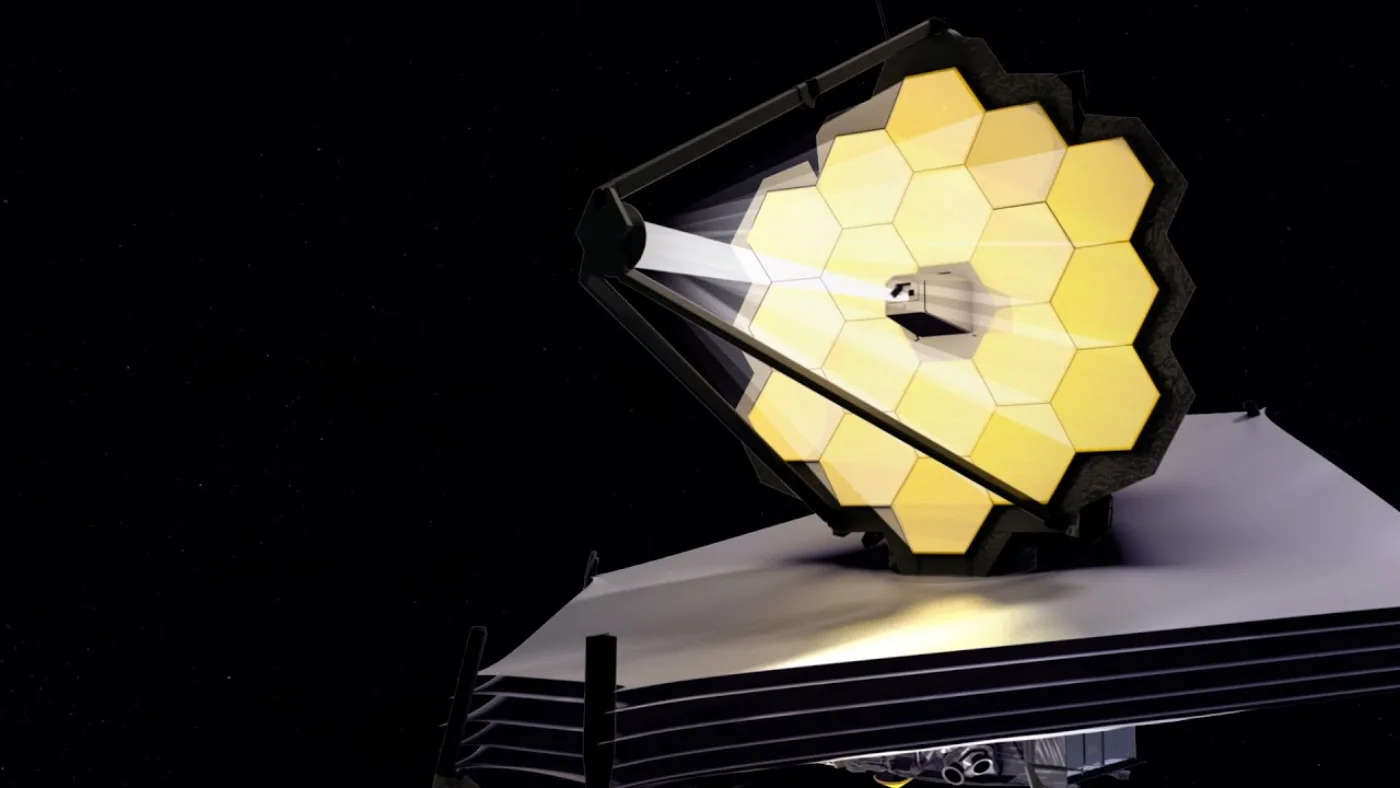
The James Webb Space Telescope, 2022 onward
The James Webb Space Telescope launched in 2021 and started sending pictures in 2022. What it saw at the edge of the observable universe made parts of the standard Big Bang model wobble in ways nobody expected.
Webb found galaxies that look too big, too bright, and too mature for their age. Labbé and colleagues (Nature, 2023) published six of them. Their light left them less than 700 million years after the Big Bang — and yet they look like they’d already spent ten billion years growing up. By the standard model, they shouldn’t be there.
The mainstream responses: maybe our galaxy formation models are wrong. Maybe the earliest stars were different than we think. Maybe the distance measurements are off. All live possibilities. What’s also on the table, but said more quietly: maybe redshift isn’t always a clean distance indicator. That’s exactly the question Arp was fighting fifty years ago. Webb hasn’t vindicated him. But the kind of problem he was worried about is suddenly live in Nature again.
And separately, there’s the Hubble tension. The universe appears to be expanding faster today than the standard model says it should, based on readings from the early universe. Adam Riess and colleagues have been measuring it for a decade. Every new measurement makes the mismatch worse, not better. Webb has sharpened the problem rather than solving it. No resolution yet.
None of this proves plasma cosmology or vindicates the heretics. It does mean the textbooks are going to need rewriting. Every time our instruments get better, the universe gets harder to fit into the standard model.
Image: NASA / ESA / CSA
The Laboratory
Anthony Peratt — Plasma in the Rock
Here’s a story that should make the hair on your arms stand up. Anthony Peratt is a plasma physicist at Los Alamos — the American national lab where the hydrogen bomb was designed. Not a fringe address. In 2003 he published something strange in the IEEE Transactions on Plasma Science.
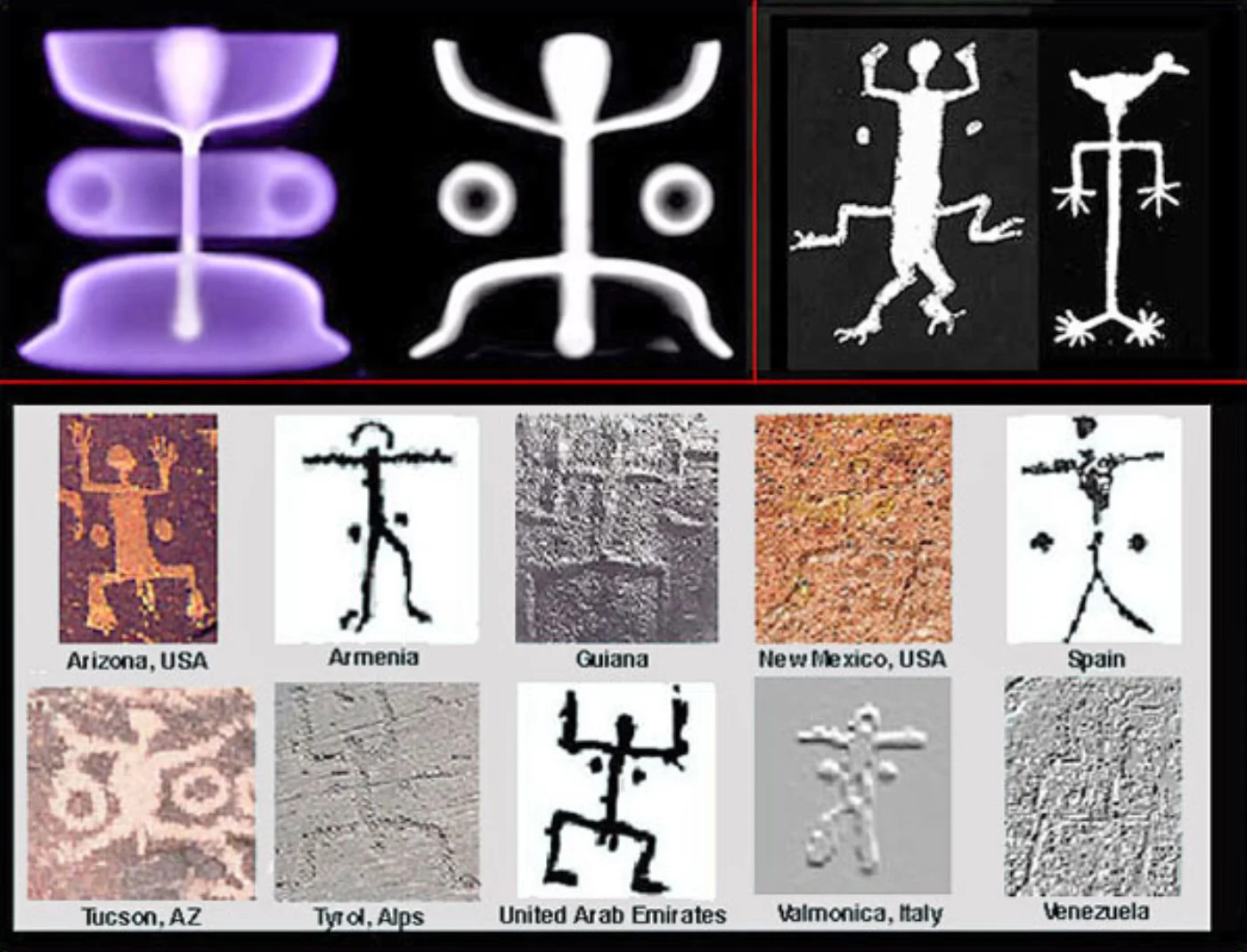
When you run a high-current plasma discharge in a lab, it makes very specific shapes — filaments that twist, pinch, and unfold in ways you can predict. Peratt studied one of those shapes for years. He called it the “squatting man.” Then he looked at ancient rock art.
The same shape, carved into stone, turns up on every inhabited continent. Arizona. Mongolia. Australia. Siberia. Geometrically identical. Cultures that never met, never traded, never shared a word of language — all drew the same diagram.
Peratt’s reading: humans everywhere on Earth, at roughly the same time, looked up and saw a massive plasma event in the sky. An extreme geomagnetic storm, or a short-lived spike in the magnetosphere — something that lit the atmosphere into shapes they’d never forget. Then they went home and carved what they saw. The rock art, in his view, isn’t mythology. It’s a record of something that actually happened overhead.
The lab physics is mainstream. The archaeological reading is contested — most archaeologists don’t buy it. But the visual match was solid enough to clear peer review at an IEEE journal, which is not a fringe outlet. Engineers have standards. Whatever actually produced those petroglyphs, the resemblance to laboratory plasma is real.
If Peratt is right, there was a moment — maybe ten thousand years ago, maybe longer — when the whole sky was on fire, and every human on Earth looked up at the same thing, and bothered to carve what they saw into the nearest rock so their grandchildren would know.
Comparison chart from Peratt’s published work. Top row: laboratory plasma discharge shapes. Bottom rows: matching “squatting man” petroglyphs from Arizona, Armenia, Guiana, New Mexico, Spain, Tucson, Tyrol (Alps), United Arab Emirates, Valmonica (Italy), and Venezuela — cultures that never met, carving the same figure.
The Structure
What 99% of the Universe Is Made Of
The part nobody argues with: more than 99% of the visible universe is plasma. Stars. Nebulae. The solar wind. The interstellar medium. The intergalactic medium. Most of what any telescope actually picks up — all of it, charged particles in electromagnetic fields. What that plasma is doing at cosmic scale is where the fight starts.
The Mainstream Model
Gravity + Dark Matter
The standard model (called ΛCDM for short) explains cosmic structure using gravity acting on ordinary matter, plus dark matter (never directly detected) and dark energy (not understood). It fits the leftover heat of the Big Bang beautifully. It also needs 95% of the universe to be made of things no experiment has ever caught.
The Plasma Alternative
Electromagnetic Structure
Plasma cosmology argues that electromagnetic forces — 1039 times stronger than gravity at the scale of single charged particles — also do real work at cosmic scale. Plasma naturally forms filaments, pinches itself into dense structures, and organises under flowing current. That could explain galaxies and the cosmic web without having to invoke stuff we can’t see.
What Lab Plasma Does
Birkeland Currents
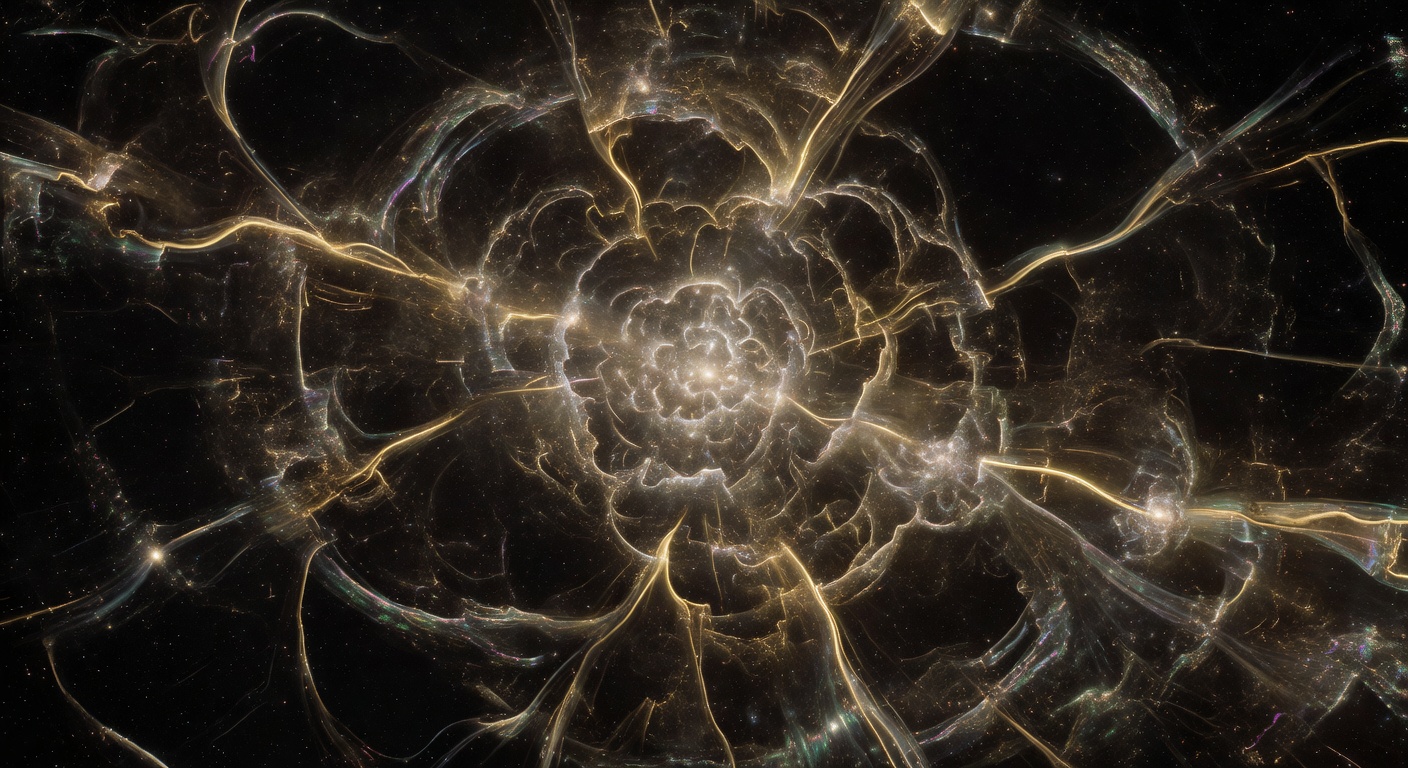
Plasma under electric current forms stringy, rope-like structures called Birkeland currents, which look remarkably like the cosmic web that modern galaxy surveys reveal. Whether that behaviour scales up cleanly from the lab to cosmic distances is the actual scientific argument.
The Inconvenient Fact
Dark Matter Is Still Missing
After forty years of hunting — underground detectors, particle colliders, orbiting experiments — dark matter has never been directly detected. Every experiment designed to find it has returned a null result. The mainstream model works beautifully if it exists. That “if” is still doing a lot of work.
The Overreach
Where it slides off the rails
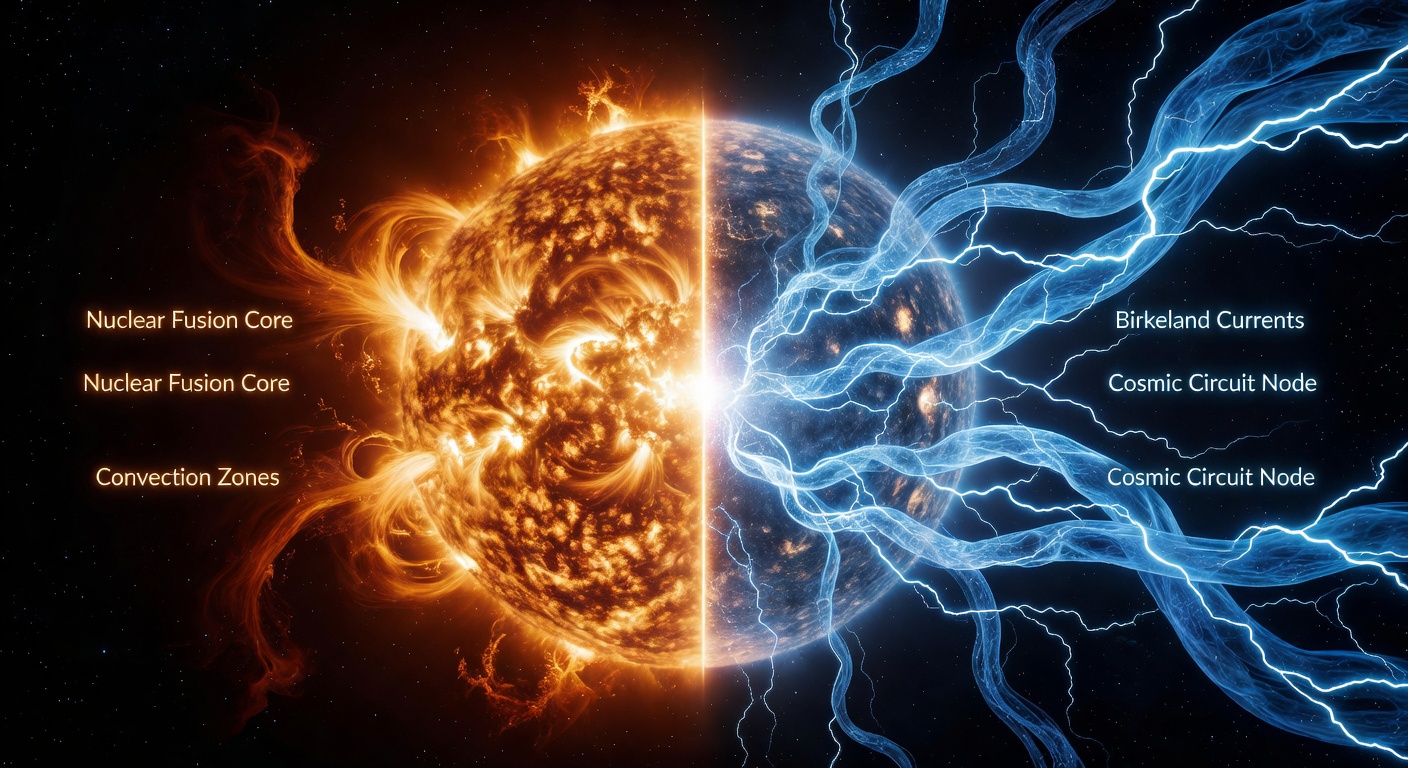
Here’s where things get loose. The Thunderbolts Project, founded by Wallace Thornhill and David Talbott, built a popular movement on Alfvén’s foundation — and then kept walking past it. The headline claims: the Sun is powered from outside by cosmic electric currents (not fusion), stars are nodes in galaxy-scale electrical circuits, and the solar system rearranged itself in recent prehistory with Saturn, Venus, and Mars dancing past each other in ways no gravity we understand would allow.
Where we draw the line: the “electric sun” idea is killed outright by solar neutrino measurements — they match internal fusion to fractions of a percent. The Saturn-Venus close-approach story needs planetary orbits to do things no known force lets them do. Both claims ride on Alfvén’s Nobel Prize like a halo — but Alfvén won that prize for careful mainstream plasma physics, not for planetary catastrophism.
It’s the oldest move in the book: use the credibility of real work to sell claims that can’t stand on their own. We won’t do that here. Good physics doesn’t need a bigger story bolted onto it to be interesting.
The Honest Position
What We Can Actually Say
Three layers. Three different levels of how sure we can be. Keep them separate and the picture is actually pretty clear.
Layer one: Alfvén’s plasma physics is mainstream science. Textbook. Not debatable.
Layer two: whether electromagnetic forces matter more at cosmic scale than standard cosmology admits is a genuinely open question. Dark matter still hasn’t been found. Arp’s bridges haven’t been fully explained away. Peratt’s rock-art match cleared IEEE peer review. These are real scientific questions, not conspiracy talk.
Layer three: the Thunderbolts Project’s bigger claims — the Sun powered from outside, Saturn close enough to touch in recent prehistory, planetary rearrangement — are not supported by the evidence and in some cases are flat-out contradicted by it. Their main mistake is using the credibility of layer one to sell layers two and three as a single bundle. We don’t do that.
Our working position: a Nobel laureate’s argument about plasma cosmology deserves more than being politely ignored by the mainstream — and more than being strip-mined by a movement that’s bolted bad catastrophism onto good physics. The universe is 99% plasma. Pretending that doesn’t matter to cosmic structure is as lazy as pretending it proves the Sun runs on an outside cable.
Sources & Further Reading
- Hannes Alfvén — Nobel Prize in Physics (1970) — for fundamental work in magnetohydrodynamics and plasma physics
- Halton Arp — Atlas of Peculiar Galaxies (1966) — anomalous redshift observations and the quasar connection debate
- Anthony Peratt — IEEE Transactions on Plasma Science (2003) — plasma instability patterns matched to global petroglyphs
- James Webb Space Telescope — launched 2021, delivering observations that put real stress on standard cosmology
- Labbé et al. — Nature (2023) — the six “impossible” early-universe galaxies JWST found
- The Hubble tension — the persistent mismatch between measured and predicted cosmic expansion rates
- Thunderbolts Project — the popular Electric Universe movement (discussed critically above)
- The Carrington Event (1859) — the most powerful geomagnetic storm in recorded history
- Maunder Minimum (1645–1715) — prolonged sunspot absence coinciding with the Little Ice Age
- NOAA Space Weather — Solar Cycle Progression — live tracking of Solar Cycle 25
Part IV — The Sky Right Now
Current Sky
October 26, 2026
Moon Phase
Full Moon
99% illuminated
Sun Position
Scorpio
Fixed water
Mercury
Scorpio
In water
Venus
Scorpio
In detriment
Mars
Leo
In fire
Jupiter
Leo
In fire
Saturn
Aries
In fall
Near-Earth Objects
39
This week · Closest: 11 LD
(opens in new tab)Solar Activity
Solar Cycle 25
Cycle Status
Declining
Started Dec 2019
Peak
~2024
Solar maximum
Sunspot Count
60
Solar Cycle 25
Latest Flare
M1.6
1 M/X-class this week
Geomagnetic
Kp 0
Quiet
Solar Cycle 25 has run hotter than any of the forecasts. Sunspot counts have consistently beaten NASA and NOAA projections. Solar maximum is behind us, but activity is still elevated.
Big flares and coronal mass ejections hit satellites, GPS timing, HF radio, and grid transformers. The Carrington Event of 1859 — the largest geomagnetic storm ever recorded — shorted out telegraph lines and set paper on fire in operator huts. A repeat today is estimated to cause trillions of dollars in damage. A CME of comparable scale missed Earth by about nine days in July 2012.
Solar cycles run about 11 years. Solar output correlates, loosely but consistently, with climate swings and sometimes with social upheaval. The Maunder Minimum of 1645–1715, a seventy-year stretch with almost no sunspots, coincided with the coldest phase of the Little Ice Age.
Source: NOAA SWPC · Updated October 26, 2026
Near-Earth Objects
What's Flying Past Us
NASA tracks every rock that passes near Earth. This week: 39 objects. Closest approach — 11 LD (comfortable margin).
(2018 GS1)
2026-Oct-28 16:15
Distance
11 LD
4,240,878 km
Speed
9.3 km/s
33,480 km/h
Size
130m
Building-sized
(2004 TP1)
2026-Nov-01 02:13
⚠ POTENTIALLY HAZARDOUSDistance
24.2 LD
9,300,135 km
Speed
12.7 km/s
45,720 km/h
Size
312m
City-killer
612856 (2004 TP1)
2026-Nov-01 02:13
⚠ POTENTIALLY HAZARDOUSDistance
24.2 LD
9,300,212 km
Speed
12.7 km/s
45,720 km/h
Size
304m
City-killer
(2015 WZ12)
2026-Oct-30 07:46
Distance
26.7 LD
10,266,782 km
Speed
10.3 km/s
37,080 km/h
Size
24m
Car-sized
516803 (2010 JG88)
2026-Oct-26 19:23
Distance
33.7 LD
12,978,707 km
Speed
20.4 km/s
73,440 km/h
Size
536m
City-killer
1 LD = 384,400 km — the distance to the Moon. Anything under 1 LD passes closer than our own satellite. NASA tags anything larger than 140 metres that crosses within 0.05 AU (about 19.5 LD) of Earth as a Potentially Hazardous Asteroid. For scale: Chicxulub, the impactor that ended the dinosaurs, was roughly 10 km wide. A 140-metre rock is a city-killer, not a planet-killer, but that is more than enough to matter to anyone living under it.
The ancients watched the sky for warnings. We do the same, with radar instead of stone circles. Same fear, better instruments.
Source: NASA Center for Near Earth Object Studies (opens in new tab) · Updated October 26, 2026
Upcoming
Eclipse & Event Calendar
Next Lunar Eclipse
Penumbral lunar eclipse
Feb 20, 2027
Next Solar Eclipse
Annular solar eclipse (Africa, South America)
Feb 06, 2027
Jupiter enters Virgo
Refinement, discernment, systems
Jul 2027
Saturn enters Taurus
Grounding, stability, material focus
Apr 2028