VII · The Conclusion
So what’s it all mean?
Seven acts. 128 texts. A 2,906-node graph. Eventually you have to stop laying out the pieces and try to put them together. So that’s what this page is.
Not “here is the truth.” More like — if you take every text seriously, where do they actually agree, where do they fight each other, and what would have to be true for any of it to be wrong.
How We Got Here
The method
Most “ancient wisdom unified” sites smooth everything together until it’s mush. We didn’t want to do that. So every claim below got scored on three things:
1 · Reach
How many separate traditions back it. Vedic and Hermetic agreeing means more than two Hermetic texts agreeing. Ten cultures that never met landing on the same idea is the strongest signal we have.
2 · Does physics agree
Does modern physics back it. Observer effect, holographic principle, non-locality, “it from bit” — where the ancient claim and the modern equation point the same direction, the claim gets stronger.
3 · Falsifier survival
What would have to be true for the claim to be wrong — and has that happened. A claim with no falsifier isn’t a claim, it’s a vibe. Every hypothesis below carries its own.
That’s the whole approach. Three tests. Five claims. Honest about what fails.
Step Zero
Flatten the vocabulary first
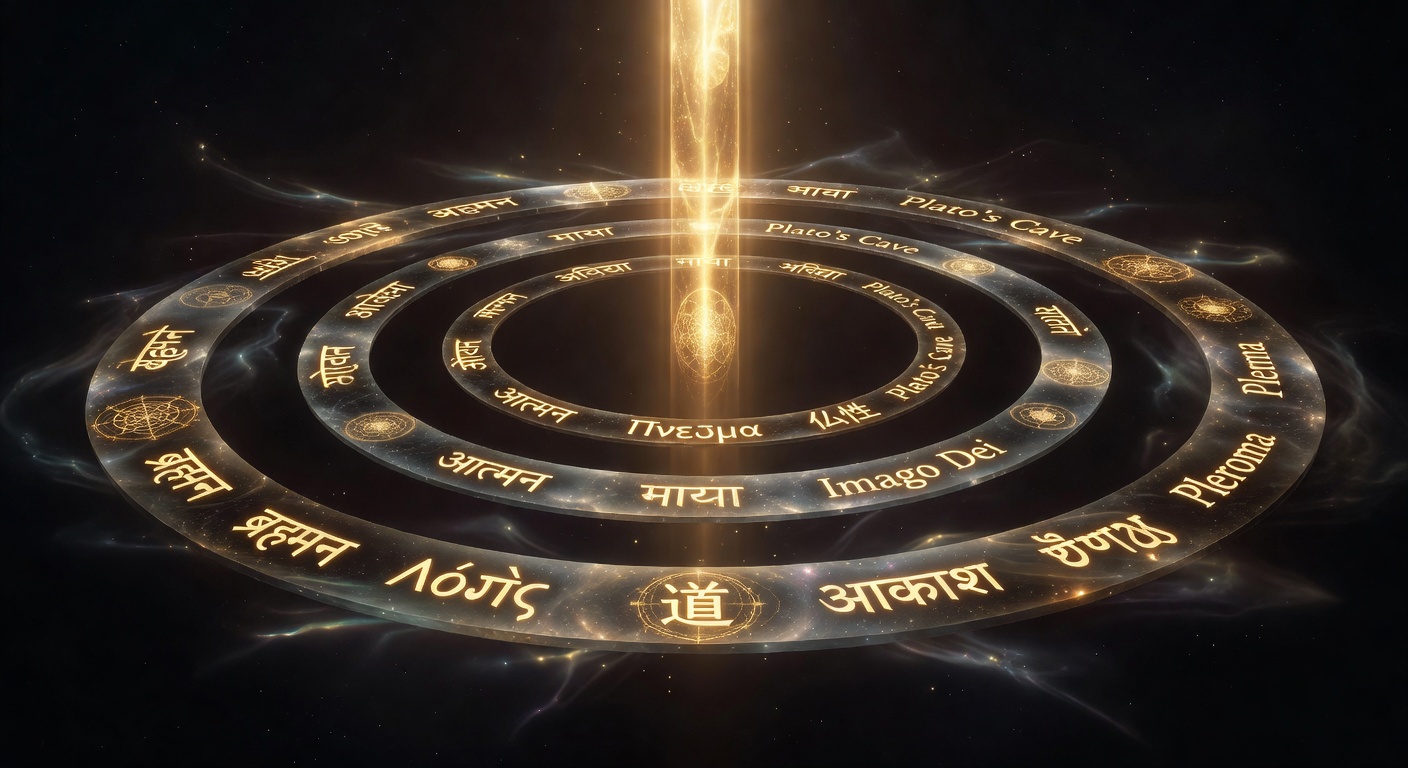
Different traditions use different words for the same thing. Before you can ask “do they agree?”, you have to notice when they’re saying the same thing in different languages.
The Ground
The fundamental source
The deepest source — everything else comes out of it. Same idea, seven names.
- Brahman · Vedic / Upanishadic
- Logos · Hellenistic / Christian
- Tao · Chinese
- Akasha · Vedic / Theosophical
- Pleroma · Gnostic
- Ein Sof · Kabbalistic
- The One · Neoplatonist
The Fragment
The individual self as part of the source
The individual consciousness as a real piece of the source — not a copy, not a creation, the actual thing in miniature.
- Atman · Vedic (“Atman is Brahman”)
- Pneuma · Greek / Christian
- Buddha-nature · Buddhist
- Spark · Gnostic
- Imago Dei · Christian
- Neshamah · Kabbalistic
- As above, so below · Hermetic
The Illusion
The world as rendered, not literal
The visible, measurable world is a screen, not the thing itself. Useful for survival, not the actual truth underneath.
- Maya · Vedic / Buddhist
- Avidya · Buddhist (“ignorance”)
- Plato’s Cave · Greek
- The Demiurge · Gnostic
- Samsara · Indian
- Hoffman’s interface · modern cognitive science
Three concepts, twenty-plus names, traditions that never met. Either it’s the most extraordinary coincidence in history, or they were all pointing at the same thing from different angles. We think it’s the second one.
The Whole Thing At Once
Sixty concepts, ten clusters, five hypotheses
This is the whole picture as a graph. The five big hypothesis dots at the centre. The three concept anchors (Ground / Fragment / Illusion) holding the places where traditions agree. Supporting traditions, modern physics, and the falsifier for each hypothesis all wired in. Drag, zoom, hover.
Loading the synthesis
63 nodes · 85 edges · the hand-picked summary graph — one slice of the full 2,906-node knowledge graph. Hover any node to see its group. The hypotheses sit at the centre because the supporting evidence pulls them there — that’s the layout doing the work on its own, not us.
The Ranked Five
What the texts and physics actually say
Five hypotheses, ranked by how much weight they carry across the three tests. Each one has its own falsifier — the line that, if crossed, would kill it.
Hypothesis 1
PlausibleHistory runs in cycles, with cataclysmic resets
Civilisations rise and fall on a 250-year clock. Empires forget what made them strong. Climate flips in a single generation, as it did 12,900 years ago. The Vedic yugas, the Greek ages, Plato’s Atlantis dialogue, the Mayan long count, Norse Ragnarök, two hundred flood myths from cultures that never met — all describe the same arc. Then the Younger Dryas evidence, the Hiawatha crater, the megalithic survivors, the conflict cycles still ticking today.
We mapped every major Pleistocene catastrophe of the last 427,000 years onto the precessional Great Year. All five major glacial Terminations land on Leo or Aquarius, alternating perfectly. See Catastrophes on the Great Year wheel.
Supporting
Vedic yugas, Hesiod’s ages, Mayan long count, Norse cycle, ~200 flood myths, Younger Dryas + 4 older Terminations on the Great Year wheel, Glubb / Strauss-Howe / Kondratieff / Khaldun, current ACLED data on /earth.
Falsifier
If the next 50 years stays politically and climatically stable, with no major civilisational reset and no return of K-Winter into K-Spring, the “cycles converging now” story is wrong — it was just seeing patterns that aren’t there.
Hypothesis 2
PlausibleThe ancients knew cosmological timing way earlier than mainstream admits
Hipparchus didn’t discover precession in 127 BCE. He rediscovered it. The same precession-derived numbers — 72, 432, 2,160, 25,920 — show up in the Vedic yugas, the Norse Valhalla numbers, the Mayan count, and the Sumerian king list. Göbekli Tepe was built by people who shouldn’t have been able to build it. The Sphinx has water erosion from a wetter era Egyptians weren’t supposed to live in.
Supporting
Precessional constants across unrelated cultures, Göbekli Tepe’s 9500 BCE date, Schoch’s Sphinx water erosion, the precession subgraph in our knowledge base.
Falsifier
If the shared numbers turn out to be coincidence (you can find any number you want by cherry-picking ancient texts) or if the early dates fail under better dating, this collapses.
Hypothesis 3
SuggestiveConsciousness comes first, not produced by matter
The hard problem of consciousness is unsolved — nobody has any idea how matter creates subjective experience, and saying “the brain does it” doesn’t answer the question, it just moves it. Meanwhile every meditative tradition that ever looked at the mind from the inside concluded awareness is the foundation, not the product. The measurement problem in QM keeps trying to put the observer in the equation. Pim van Lommel and Sam Parnia’s NDE studies show real, accurate seeing during clinical death.
Supporting
Vedanta, Buddhism, Hermetism, Gnosticism, Plotinus, the QM measurement problem, Bohm’s implicate order, Hoffman, Penrose-Hameroff, the AWARE study.
Falsifier
If neuroscience produces a clean physical explanation for subjective experience — an actual cause, not just a list of patterns that line up — this becomes unnecessary. Hasn’t happened in 70 years of trying.
Hypothesis 4
SuggestiveReality is a survival-tuned screen, not the truth underneath
What we see, hear, and measure is a screen built for keeping the body alive long enough to reproduce. It is not what’s actually there. Donald Hoffman calls this the interface theory; the Vedic tradition calls it Maya; Plato called it the cave; the Gnostics called it the demiurge’s workshop. The QM measurement problem suggests the same thing from the physics side — the world doesn’t have set values until something looks. Reality is the foundation. The screen is what shows up on top of it.
Supporting
Hoffman’s evolutionary game theory, Vedanta’s Maya, Plato’s cave, the Gnostic demiurge, the QM measurement problem, holographic principle (Bekenstein / ’t Hooft / Susskind).
Falsifier
If physics turns out to be cleanly local, predictable, and unaffected by who’s looking at every scale, this collapses. The observer effect is the load-bearing wall.
Personal note: this is the one the curator finds most convincing. That’s a bias worth flagging — it doesn’t mean the others are wrong.
Hypothesis 5
SpeculativeInformation / consciousness is the foundation
The strongest version of the previous hypothesis. Not just “reality is rendered” but “the underlying thing being rendered is information itself, and consciousness is that information knowing itself.” Wheeler’s “it from bit.” Bohm’s implicate order. The holographic principle. The Akashic Records as a literal information foundation. The Logos. Brahman. This is the most beautiful answer and also the hardest to pin down with anything testable.
Supporting
Wheeler’s “it from bit,” the holographic principle, Bohm’s implicate order, the Akashic concept, John 1:1 (“In the beginning was the Logos”), the Hermetic “all is mind.”
Falsifier
No clean falsifier exists yet. That’s exactly why it’s in the Speculative band. Beautiful pattern, no test — not the same as truth.
The Conclusion
The honest answer, in layers
No single sentence does this justice. So we layer it — from the things almost every tradition agrees on, down to the parts that are still just personal guesses.
Layer I
High Confidence · Near-ConsensusConsciousness comes first. The visible world is a screen, not the truth underneath. Time runs in cycles with resets. The individual self is a real piece of the same source.
Vedic, Buddhist, Hermetic, Gnostic, Platonic, Indigenous, and modern meditative traditions all land on these four on their own. Different words. Same shape.
The deepest foundation is awareness itself. Mountains, oceans, galaxies, bodies — the visible world comes out of it like a picture cast from a deeper layer.
Layer II
Medium Confidence · Most Agree, Some Don’tThe screen has a maker. Coming back, remembering, waking up — that’s the point.
Most traditions agree there’s something behind the curtain shaping things. They split on whether it’s friendly (the Logos, the Tao, the One) or hostile (the Gnostic demiurge, samsara’s grinding wheel).
Most also agree the goal is to remember and return — but they split on whether that means escape (gnostic, classical Buddhist) or becoming one with it (tantric, Christian, late Vedanta). Don’t smooth those splits over.
Layer III
Lower Confidence · Physics Hints At It, Still A GuessThe foundation is information. The observer literally shapes what’s observed. As above, so below isn’t a poetic image — it’s how things are actually built.
Modern physics keeps wandering toward this without saying it out loud. “It from bit.” The holographic principle. The measurement problem. Non-locality. Penrose-Hameroff orchestrated reduction.
None of them are settled. All of them point in the same direction — and the direction they point is the one the contemplative traditions have been pointing for three thousand years.
Layer IV
The Curator’s Reading · Pattern Across Traditions“The real world is within you. The physical reality we observe is just shown to us the way we — as creatures of evolution — need to see it, in order to survive.”
That’s the curator’s distillation — but it isn’t personal opinion. The observation that the real world lives inside, and that the outside is a screen optimised for survival, runs through every contemplative tradition we’ve read. They don’t agree on the metaphysics. They do agree on the direction.
The exact wording — including the Hoffman / evolutionary frame — is the curator’s synthesis. The substance underneath is widely attested.
The inward turn, across traditions
The instruction to look inside, not outside, isn’t novel. Every tradition we cite makes some version of this move — in different vocabularies, in cultures that didn’t share scripture.
Christianity
“The kingdom of God is within you.”
Jesus, Luke 17:21 (KJV). Greek entos hymōn estin. Some modern translations render “among you” — the within-reading is the older one and the one early mystics ran with.
Gnosticism
“The kingdom is inside of you, and outside of you. When you come to know yourselves, then you will be known.”
Gospel of Thomas, Logion 3. Found at Nag Hammadi 1945. Direct, unambiguous, predates the canonical synoptics by some readings.
Buddhism
“Be a lamp unto yourselves. Be a refuge unto yourselves. Take no other refuge.”
The Buddha, Mahaparinibbana Sutta (DN 16). The Pali atta-dīpā. Meditation goes inward; the Buddha doesn’t direct anyone to look up.
Vedanta
“Tat tvam asi — thou art that.”
Chandogya Upanishad 6.8.7. The Atman within you is the Brahman of everything. The most direct possible identity claim between the inner self and the ground of being.
Bhagavad Gita
“Let a man lift himself by his own Self alone; let him not lower himself; for the Self alone is the friend of the self.”
Krishna to Arjuna, Bhagavad Gita 6:5. The whole battle of the Gita is read by the contemplative tradition as the inner battle — Kurukshetra inside the practitioner.
Sufism
“He who knows himself knows his Lord.”
Man arafa nafsahu faqad arafa Rabbahu. Hadith of debated authenticity but central to Sufi practice from Ibn Arabi onward. Same direction, in Arabic.
Hermeticism / Greek
“Know thyself.”
Gnōthi seauton. Inscribed at the Temple of Apollo at Delphi, predating Socrates. Plus the Hermetic “as above, so below” — the inside is the map of the outside.
Neoplatonism
“Withdraw into yourself and look.”
Plotinus, Enneads I.6.9. The first instruction of contemplation. The One isn’t up there; it’s found by going in.
Eight traditions, no shared scripture, same direction. The curator didn’t make this up — the texts did. What’s personal is connecting them to Donald Hoffman’s evolutionary interface theory and the QM measurement problem in one sentence. The inward turn itself is the most well-attested cross-cultural observation in the corpus.
That’s the conclusion. Layered, honest about what’s solid and what isn’t, with the falsifier line per layer.
Where The Work Is
Where the evidence lives
This page ties it all together. The actual evidence lives on the chapters before it — and on the seven pattern pages where the knowledge graph clusters tell the story visually.
Pattern · Precession
The 26,000-year code
Evidence for hypothesis 2 — ancients knew the timing.
Pattern · Flood Memory
200 cultures, one story
Evidence for hypothesis 1 — cataclysmic resets.
Pattern · Great Year wheel
5 Terminations, alternating Leo & Aquarius
Evidence for hypothesis 1 — precessional cataclysm timing across 427K years.
Pattern · Buddhism + QM
Where the Buddhists and the physicists agree
Evidence for hypotheses 3 and 4 — consciousness primary, world rendered.
Pattern · Divine Feminine
Sophia, Shakti, Isis — same intercessor
Evidence for the convergence map.
Pattern · Dying-Rising God
Osiris, Tammuz, Christ — same archetype
Evidence for the convergence map.
Pattern · Sacred Geometry
The same shapes, everywhere
Evidence for hypothesis 5 — information foundation.
Pattern · Information Foundation
“It from bit” meets the Akashic Records
The deepest version of hypothesis 5 — information as the underlying thing.
Each pattern page renders its own slice of the 2,906-node knowledge graph. All eight pattern explorations · full graph at /graph.
Push Back On Any Of This
The Oracle reads everything we just cited
Disagree with a hypothesis? Want a tradition we missed? Curious how we’d defend layer 3 against someone who thinks only matter is real? Ask. The Oracle will pull the actual texts and physics, with citations you can click, and won’t pretend to know what it doesn’t.
Challenge the conclusionWe’d rather be honestly wrong than dishonestly right.
Where We Are
Every cycle at once
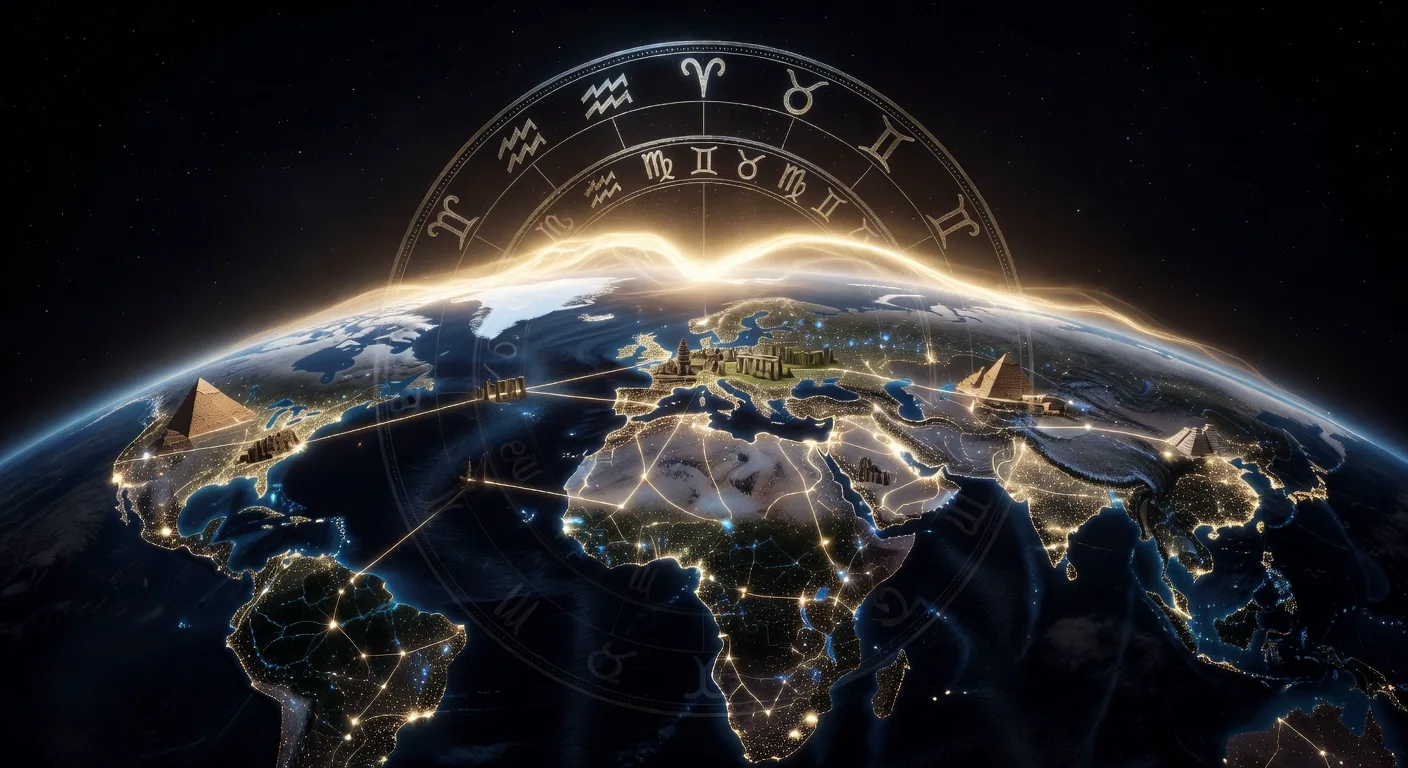
We’re 250 years out from 1776 (Glubb’s empire lifespan). Inside a Fourth Turning crisis phase (Strauss–Howe, started around 2008). In Kondratieff Winter (debt unwinding since 2007). Shifting into the Age of Aquarius (the precessional drift — see /cosmos). Magnetic field weakening (see /earth). The ancients tracked every one of these cycles. We somehow lined up on all of them in the same decade.
That’s the situation. The ancients tracked the clocks. We’re the ones living through the alignment.