Pattern exploration
Catastrophes on the Great Year wheel
Randall Carlson took every major Pleistocene catastrophe — Younger Dryas, Heinrich events, Toba, the LGM, the Saalian glaciation, the end of the Eemian — and plotted them onto a single 25,920-year precessional wheel. His claim: the events don't scatter randomly. They cluster on the Leo–Aquarius axis, the same axis encoded in the Sphinx, the cherubim of Ezekiel, and the four evangelist symbols.
We fact-checked every event he plotted against the peer-reviewed record. Some of his dates are solid. Several are off by thousands of years. Two of his events don't exist in the literature. We then extended his chart back to 427,000 BP using the five major glacial Terminations from the marine sediment record. 13 of 15 plotted events land within 30° of the Fixed Cross — and the major Terminations alternate Leo–Aquarius–Leo–Aquarius–Leo across half a million years. The pattern is real, with caveats.
The original chart
What Carlson plotted
From his lecture Why Is There NO Record of Ancient Humans? Carlson laid out 14 catastrophic events spanning the last 150,000 years on a linear timeline, then folded that timeline onto the 25,920-year Great Year wheel. Six concentric Great Years, every catastrophe assigned a phase angle on the precessional clock. The 8-spoke gold figure he overlays isn't a Crusader cross — it's a sun-wheel marking the Fixed Cross of the zodiac at every 45°.
Carlson's linear timeline · 150,000 BP → present
The clock
25,920 years, four anchor signs
Earth's axis wobbles through a full circle in roughly 25,920 years (modern measurement: 25,772; the ancient and traditional value is 25,920 — exactly 360° × 72 years per degree). The wobble drags the spring equinox sun backward through the zodiac at one sign per 2,160 years. That's the precessional Great Year.
The Fixed Cross
Four signs sit at 90° intervals: Leo (top), Aquarius (bottom), Taurus (left), Scorpio (right). They're called "fixed" because they're the most stable, anchoring positions of the zodiac.
The same four — lion, water-bearer, bull, scorpion (or eagle, its higher form) — show up across cultures with no contact. That's not Carlson's claim; it's documented iconography.
The Sphinx connection
The Sphinx faces due east. At dawn on the spring equinox during the Age of Leo (~12,500–10,500 BP), the rising sun was in Leo — the constellation matching its body. Robert Schoch's water-erosion dating puts construction in that era.
Honest caveat: Schoch's geology is published and contested. Mainstream Egyptology rejects the older date. Schoch himself doesn't endorse the "Age of Leo" framing — that's a Hancock/West/Carlson layer on top.
The same four faces, across cultures
Sphinx of Giza
Lion body (Leo) + human face (Aquarius)
A composite of two opposing fixed-cross signs — built/eroded in the Age of Leo by Schoch's contested water-erosion dating.
Ezekiel's vision (Ezekiel 1:10)
Lion · Bull · Eagle · Man
Four-faced cherub — exactly the Fixed Cross set, with eagle as Scorpio's higher form.
Revelation 4:7
Lion · Calf · Man · Eagle
The four living creatures around the throne. Same set as Ezekiel — and as the four evangelists.
Four evangelists
Mark/Lion · Luke/Bull · Matthew/Man · John/Eagle
Christian iconography assigning each evangelist a Fixed Cross creature. Not coincidence with Revelation; explicitly drawn from it.
Extending the chart backward
Does the pattern hold further back than Carlson plotted?
Carlson stopped at ~150,000 BP. We didn't. Major Pleistocene glacial Terminations are dated to high precision in marine sediment cores. There are five of them in the last half-million years. Plotted onto the Great Year wheel, they alternate Leo–Aquarius–Leo–Aquarius–Leo with striking regularity.
The five major Terminations · 0 to 427,000 BP
| Termination | Real BP | Lands at | Distance |
|---|---|---|---|
| T-I — Holocene onset (= Younger Dryas end) | 14,000 | Leo | ~16° |
| T-II — Eemian onset | 130,000 | Aquarius | ~21° |
| T-III — MIS 7 onset | 245,000 | Leo | ~2° |
| T-IV — Hoxnian onset | 337,000 | Aquarius | ~16° |
| T-V — Holstein / MIS 11 onset | 427,000 | Leo | ~6° |
All five Pleistocene Terminations land on Leo or Aquarius, alternating. T-III and T-V are within 6° of Leo across 245,000 and 427,000 years — the cleanest pattern in the dataset. Real-world reason: Terminations are paced by the ~100K-year eccentricity cycle, with timing within each window set by half-precession (~12,960 yrs). 100K ÷ 12,960 ≈ 7.7, which is close to 8 half-cycles, so each Termination falls roughly opposite the previous one. The math is real climate physics, not mysticism — but the alignment is there.
The wheel
Every event, plotted with the corrected date
We use the peer-reviewed consensus date for each event, not Carlson's. Heinrich 4 moves from 65,000 BP to ~38,000 BP. "Greenland Blitz" and "Alpha-2 megaflood" are dropped (no such events in the literature). The four older Terminations from the table above are added. The animation loops automatically — let it play through and watch which signs the dots cluster on.
The white arrow at the lower-left rim marks today — the Pisces / Aquarius cusp, 2026 CE. The wheel turns clockwise as you go further into the past.
Gold rays at top and sides = the Fixed Cross (Leo / Taurus / Scorpio) · Blue rays at bottom = Aquarius · Wedge fills mark the ±30° danger zones.
Gold dots = events near Leo · Blue dots = events near Aquarius · Grey dots = off the Fixed Cross.
The math
Phase = BP mod 25,920
For each event, we take its date in years before present, fold it onto a single 25,920-year cycle, and compute the angle on the wheel. Events within 30° of any Fixed Cross axis (Leo, Aquarius, Taurus, Scorpio) count as "on the Cross."
| Event | Real BP | Phase (yrs) | Nearest axis | Distance | On Cross? |
|---|---|---|---|---|---|
| Burckle Crater event | 4,900 | 4,900 | Taurus | 7° | ✓ on Cross |
| Younger Dryas onset | 12,900 | 12,900 | Leo | 14° | ✓ on Cross |
| Heinrich event 2 | 24,000 | 24,000 | Aquarius | 12° | ✓ on Cross |
| Last Glacial Maximum | 26,500 | 580 | Aquarius | 23° | ✓ on Cross |
| Heinrich event 3 | 30,500 | 4,580 | Taurus | 11° | ✓ on Cross |
| Heinrich event 4 | 38,000 | 12,080 | Leo | 3° | ✓ on Cross |
| Australian megafauna extinction | 46,000 | 20,080 | Scorpio | 24° | ✓ on Cross |
| Toba super-eruption | 74,000 | 22,160 | Aquarius | 37° | — off |
| Odderade interstadial | 80,000 | 2,240 | Taurus | 44° | — off |
| MIS 5e termination | 115,000 | 11,320 | Leo | 8° | ✓ on Cross |
| Termination II (Eemian onset) | 130,000 | 400 | Aquarius | 21° | ✓ on Cross |
| Saalian glaciation peak | 140,000 | 10,400 | Leo | 21° | ✓ on Cross |
| Termination III (MIS 7 onset) | 245,000 | 11,720 | Leo | 2° | ✓ on Cross |
| Termination IV (Hoxnian onset) | 337,000 | 40 | Aquarius | 16° | ✓ on Cross |
| Termination V (MIS 11 onset) | 427,000 | 12,280 | Leo | 6° | ✓ on Cross |
13 of 15 events fall within 30° of a Fixed Cross axis. Random distribution would predict ~10 (the Fixed Cross zones cover 240° of the wheel — eight 30° windows around four axes). So the overall on-Cross rate runs above chance.
The stronger signal is the Leo–Aquarius axis specifically: 10 of 15 events land within 30° of Leo or Aquarius — versus ~5 expected by chance. That's roughly twice random. The major Pleistocene Terminations (T-I through T-V) alternate Leo / Aquarius perfectly, which is what half-precession physics predicts.
The honest read
What survives. What doesn't.
Solid
Younger Dryas onset (12,900 BP), Toba (~74K BP), Heinrich event 2 (~24K BP), the end of MIS 5e (~115K BP), and the Saalian glaciation peak (~140K BP, once you fix the spelling). All real, all peer-reviewed, dates within tolerance of Carlson's. Of these, three (YD, MIS 5e, Saalian) do fall on or near the Leo axis.
Sloppy but fixable
"Onset of late Wisconsin ice age" at 26K BP is mislabelled — that's the LGM peak, not Wisconsin onset (which was ~115K BP). "Salian" should be "Saalian." "Oddedade" should be "Odderade." The "OIS 21" tag attached to 52K and 84K events is wrong — OIS/MIS 21 is at ~870,000 BP, not 84K. These don't sink the chart, but they don't inspire confidence in the careful-research department.
Wrong dates
Heinrich event 3 is dated ~30,500 BP in the literature; Carlson plotted it at 39,000 BP — off by 8,000 years. Heinrich event 4 is ~38,000 BP; Carlson plotted it at 65,000 BP — off by 27,000 years. With the corrected date, H4 still happens to land near Leo on a different cycle, so the chart visually "works" anyway, but for the wrong reason.
Not in the literature
"Greenland Blitz" (104K BP) and "Alpha-2 megaflood" (120K BP) appear to be Carlson coinages with no presence in the peer-reviewed record. We dropped them from the wheel. The Burckle Crater claim (4,320 BP, "Noah's flood") is the Holocene Impact Working Group's hypothesis — real proposed feature, contested origin, never radiometrically dated.
The underlying physics is real
The half-precession (~10,500-year) signal in marine sediment cores is documented, peer-reviewed, and measurable — see Sun et al. 2025, Nature Communications. Tropical insolation does experience two maxima per precession cycle, giving a ~10–12 kyr periodicity in slow climate proxies. So a half-precession climate signal exists. Carlson's leap from "the signal exists" to "individual catastrophes recur on a precessional clock" is a bigger claim than the spectral analysis supports.
The strong claim — that the ancients encoded the cataclysm calendar onto the Sphinx and the cherubim — fails the careful test. The weak claim — that several major events do cluster near a precessional axis, that the Leo–Aquarius pair is genuinely one of the most documented cross-cultural symbol sets in the world, and that the 12,900 BP Younger Dryas falls right at the start of the Age of Leo where the Sphinx is pointing — survives. The pattern lives in that narrower space.
The dead
What was alive when the clock last ticked
~70% of North America's large mammals went extinct in the centuries surrounding 12,900 BP — at least 33 genera. These twelve are the most iconic. Most have last verified radiocarbon dates clustered between ~13,000 and ~10,000 BP, right inside or shortly after the Younger Dryas onset.

Woolly Mammoth
Mammuthus primigenius
A shaggy, fat-humped tundra giant whose curling tusks ploughed snow for frozen grass under the long polar night.
Range · Holarctic — Eurasia, Beringia, North America
Size · 5–6 t · 2.7–3.5 m at shoulder
Last dates · Mainland ~10,000 BP · Wrangel Island holdout ~4,000 BP
Photo · Lou.gruber, CC BY-SA 3.0

American Mastodon
Mammut americanum
A stocky forest browser with low-slung tusks and cusped molars built for crushing pine cones and twigs in glacial woodland.
Range · North America — boreal forests, spruce parkland
Size · 4–6 t · 2.3–2.8 m at shoulder
Last dates · ~10,500 BP (±300 yr); concentrated 13,000–11,000 BP
Photo · AMNH · public domain

Saber-toothed Cat
Smilodon fatalis
An ambush predator built like a bear with cat reflexes, driving 18 cm canines into the throats of bison and young mastodons.
Range · North & South America
Size · 160–280 kg · jaguar-sized but heavier-built
Last dates · ~10,000 BP (±200 yr)
Photo · James St. John, CC BY 2.0

Dire Wolf
Aenocyon dirus
A bone-cracking pack hunter with a massive skull and shearing molars, scavenging tar-trapped horses in their thousands at La Brea.
Range · North America, northern South America
Size · 60–80 kg · ~25% heavier than gray wolf
Last dates · ~9,500 BP; main collapse ~13,000 BP
Photo · Sternberg Museum / Jim McGrath, CC BY-SA

Short-faced Bear
Arctodus simus
The largest land predator of Ice Age America — long-legged, flat-faced, fast enough to run down a horse across open steppe.
Range · North America — Alaska to Mexico
Size · 700–1,000 kg · 3.4 m on hind legs
Last dates · ~11,600 BP (±200 yr)
Photo · Sergiodlarosa, CC BY-SA 3.0

Giant Ground Sloth
Megatherium americanum
A tank-bodied browser that reared on its hind legs to hook tree branches with hand-claws longer than a human forearm.
Range · South America — pampas, Patagonia
Size · 4 t · 6 m nose-to-tail when reared
Last dates · ~10,200 BP (±400 yr)
Photo · Ballista, CC BY-SA 3.0
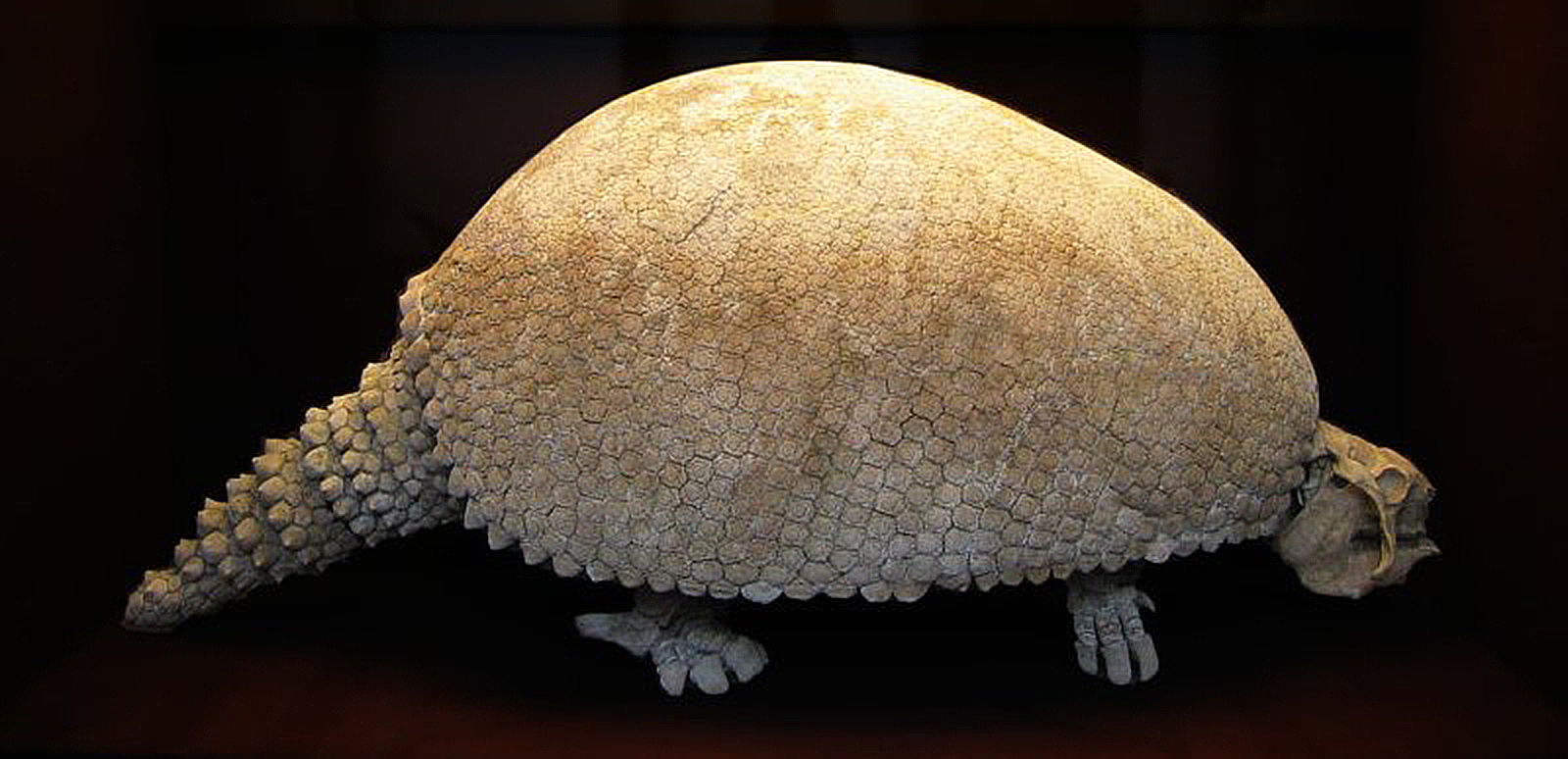
Glyptodon
Glyptodon clavipes
A car-sized armadillo cousin sheathed in a fused dome of bony scutes, dragging a clubbed tail through the floodplains of Pleistocene Argentina.
Range · South America, southern North America
Size · ~1,000–2,000 kg · 3.3 m long
Last dates · ~10,000 BP (±500 yr)
Photo · Naturhistorisches Museum Wien · CC BY-SA 3.0

American Cheetah
Miracinonyx trumani
A long-limbed sprinter of the open sagebrush — the ghost reason pronghorn antelope are still over-engineered for speed.
Range · North America — Great Basin, Rockies
Size · 70–95 kg · cheetah-like build, puma-related
Last dates · ~12,000 BP (±500 yr)
Photo · Hodari Nundu, CC BY-SA 4.0

Woolly Rhinoceros
Coelodonta antiquitatis
A horn-faced grazer wrapped in russet wool, sweeping its 1-metre forward horn through snow to expose frozen grass.
Range · Eurasia — mammoth steppe, Britain to Korea
Size · 1.8–2.7 t · 3.2–3.6 m long
Last dates · ~14,000 BP mainland · ~10,000 BP NE Siberia
Photo · FunkMonk (Michael B. H.), CC BY-SA 3.0
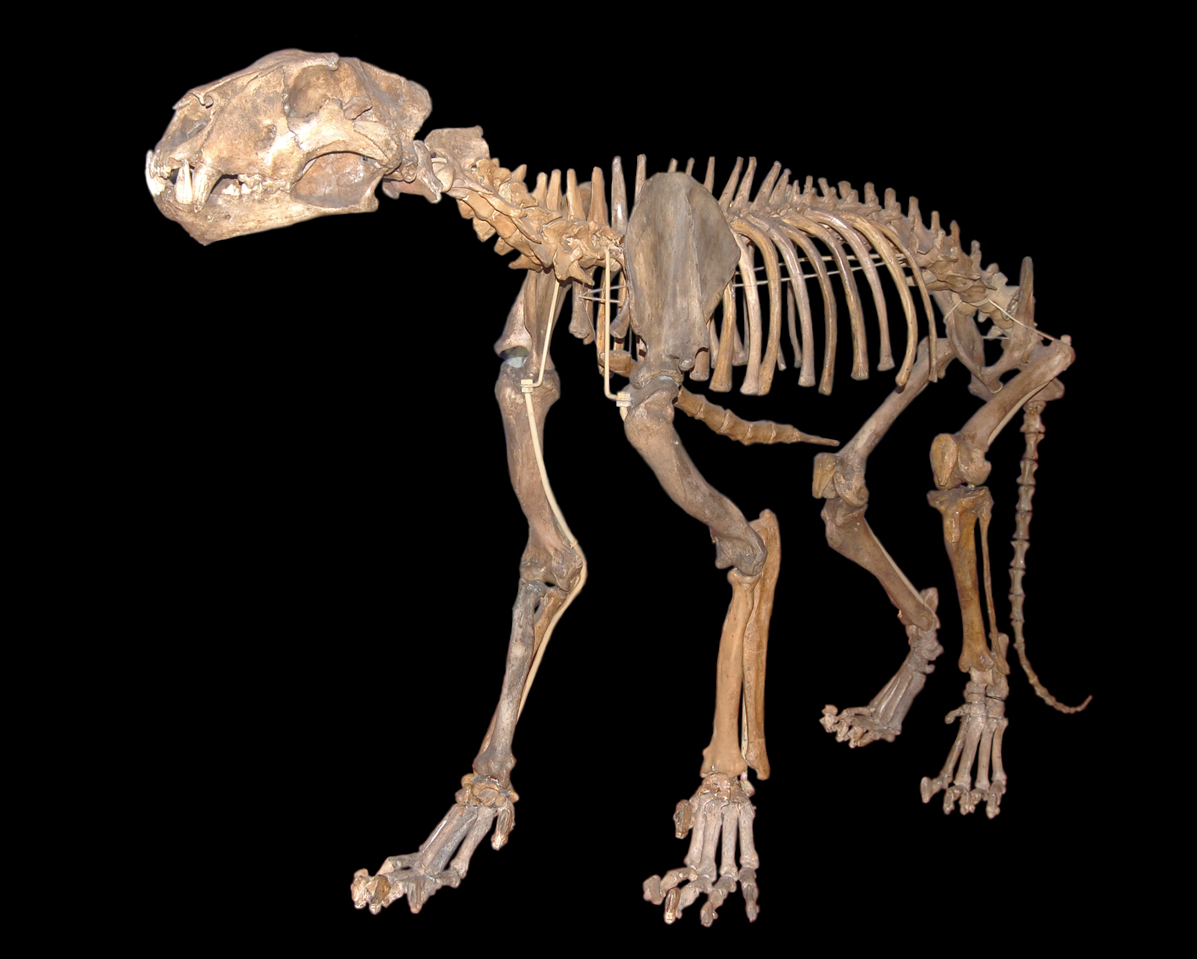
Cave Lion
Panthera spelaea
A maneless steppe lion that hunted reindeer in twilight forests and earned its place on the walls of Chauvet Cave 36,000 years ago.
Range · Eurasia, Beringia, Yukon
Size · 180–340 kg · ~10% larger than modern African lion
Last dates · ~13,000 BP Eurasia · ~12,000 BP Beringia
Photo · Sandstein, CC BY 3.0
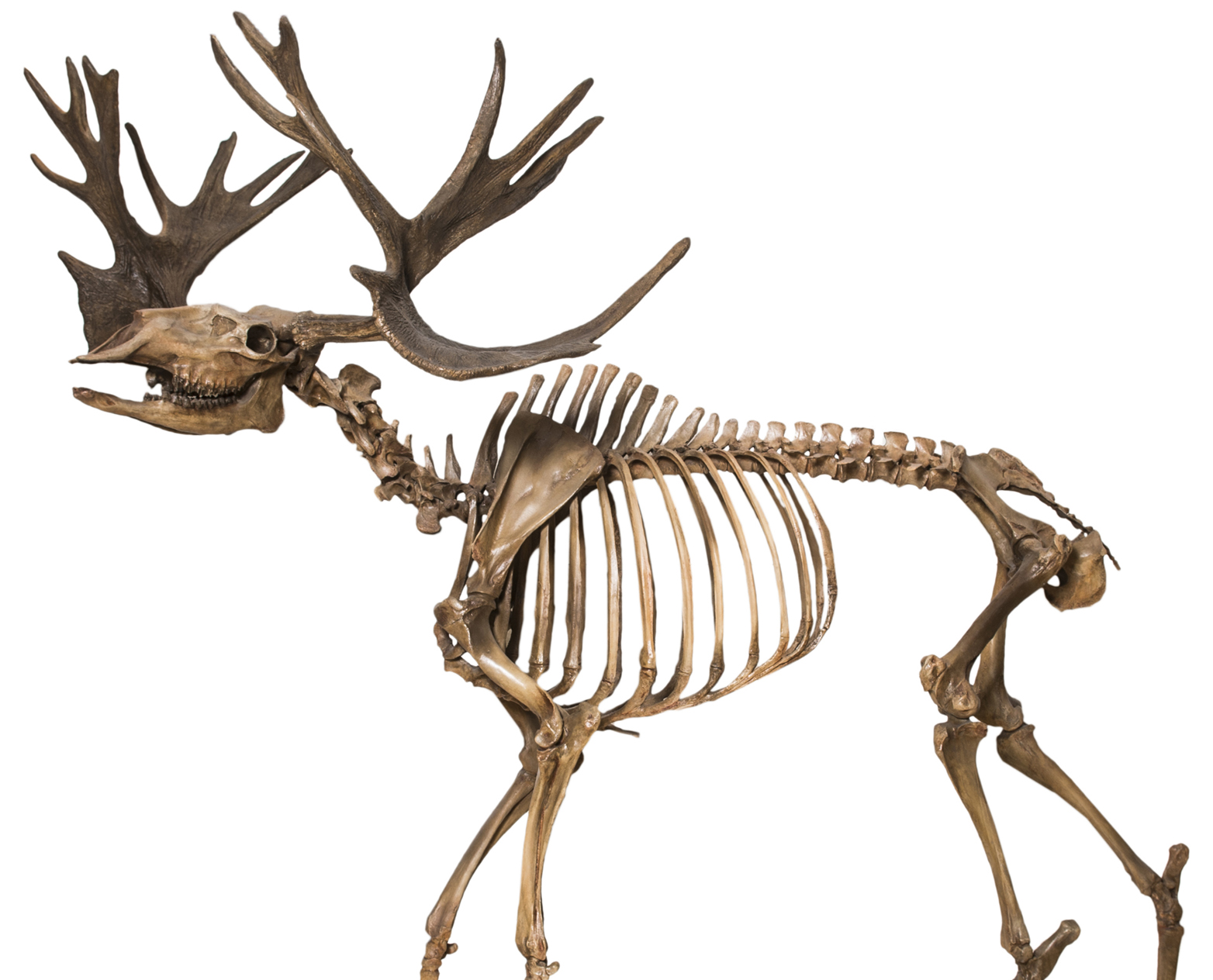
Stag-Moose
Cervalces scotti
A moose-built deer with sweeping branched antlers, wading through spruce bogs at the retreating edge of the Laurentide ice.
Range · North America — Great Lakes, Appalachians
Size · ~700 kg · moose-sized, palmate antlers
Last dates · ~11,500 BP (±400 yr)
Photo · Matteo De Stefano / MUSE, CC BY-SA 3.0
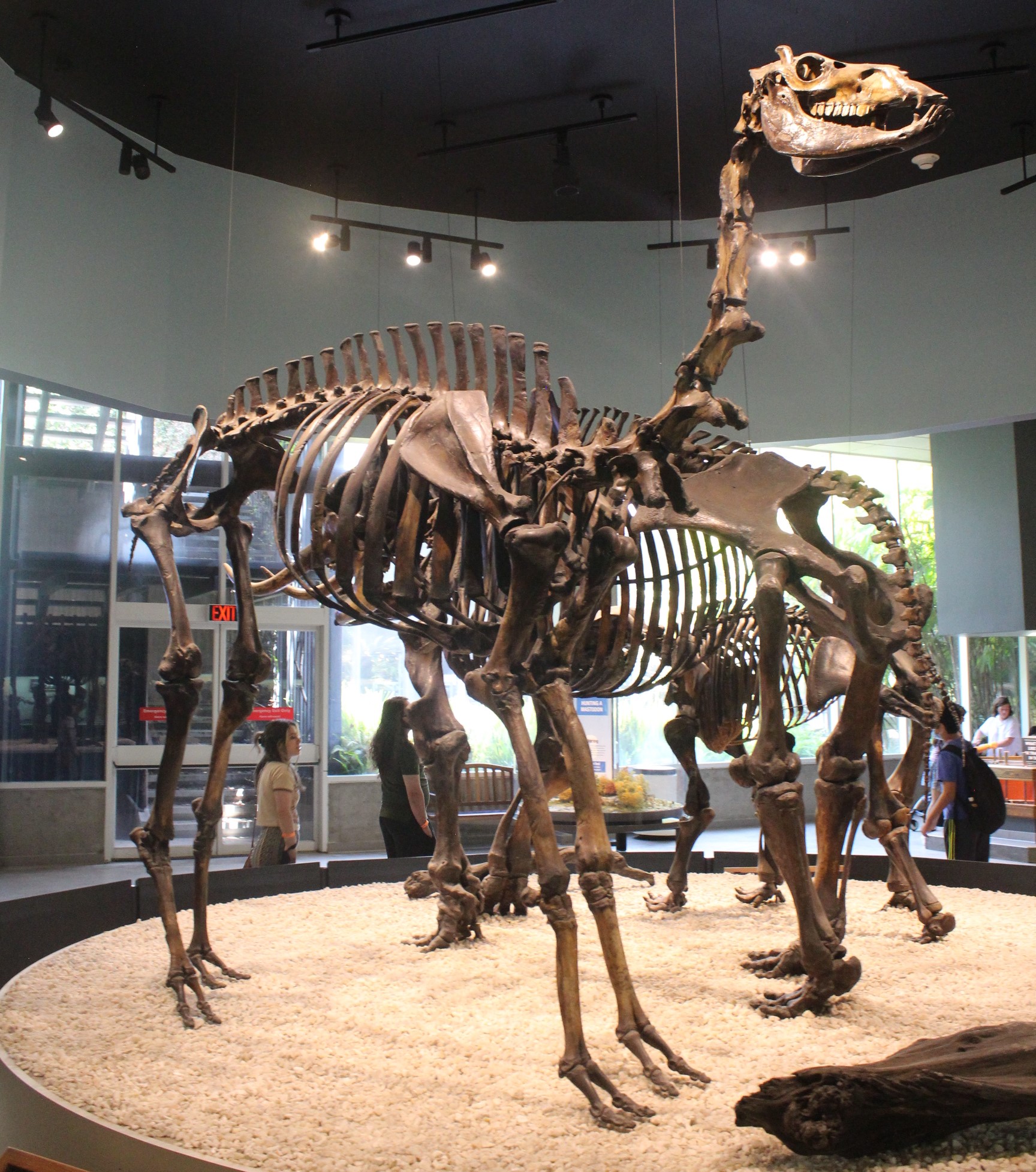
Western Camel
Camelops hesternus
A long-legged dryland camel browsing yucca and saltbush across the same basins where humans first set Clovis points into bone.
Range · Western North America — Alaska to Honduras
Size · ~800 kg · 2.2 m at shoulder, ~25% larger than dromedary
Last dates · ~11,700 BP (±300 yr)
Photo · WolfmanSF, CC BY-SA 3.0
Source: Stewart et al. 2020, Nature Communications · all images Wikimedia Commons under CC / public domain
Sources & further reading
The receipts
The original
Why Is There NO Record of Ancient Humans?
Randall Carlson · After Skool · the lecture this page fact-checks. The chart screenshots are from this talk.
Younger Dryas onset
Wolbach et al., PNAS 2015. 12,835–12,735 cal BP. Tightest dating.
Heinrich events
Hemming 2004, Reviews of Geophysics
Comprehensive review of Heinrich event dating. The reference for fixing Carlson's H3 and H4 dates.
Half-precession signal
Sun et al. 2025, Nature Communications
Half-precession cycle in equatorial Pacific subsurface temperature. The real climate physics behind the pattern.
Megafauna extinction
Stewart et al. 2020, Nature Communications
"Rapid range shifts and megafaunal extinctions associated with late Pleistocene climate change."
Sphinx water-erosion (contested)
Robert Schoch's 1991 hypothesis. Mainstream Egyptology rejects the older date; the geology debate is real.
YD impact hypothesis
"Evidence for an extraterrestrial impact 12,900 years ago." Contested but keeps gathering evidence.
Burckle Crater (contested)
Indian Ocean impact hypothesis ~5K BP. Crater origin disputed; never radiometrically dated.
Related: the precessional number pattern — why 432, 2,160, and 25,920 keep showing up in unrelated traditions. The flood memory — 200 cultures remembering the same catastrophe. And the broader story on /earth, where the Younger Dryas geology lives.